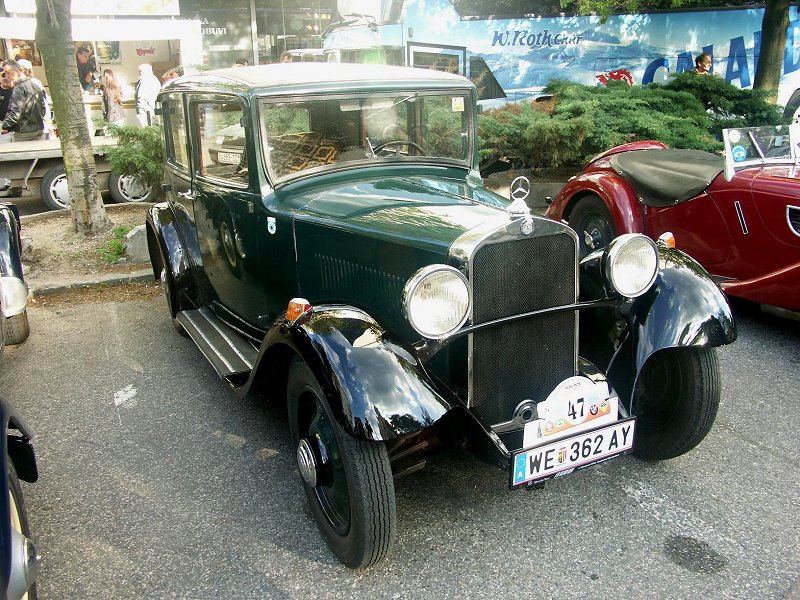
Description
The Mercedes-Benz 170 was one of the most important and influential models in the company’s pre-war lineup, introduced in 1931 as a practical, refined and technically advanced family car. It represented a decisive shift for Mercedes-Benz: instead of focusing solely on large luxury vehicles and supercharged performance machines, the company broadened its reach with a smaller, more affordable model that still carried the marque’s engineering integrity. The result was a car that appealed to middle-class buyers, professionals and taxi operators, eventually becoming one of Mercedes’ best-selling models of the 1930s.
At the centre of the 170 was its 1.7-litre inline-four engine, a robust and economical unit producing around 32–38 horsepower depending on the year and carburetion. Though modest in output, the engine delivered good torque for everyday use, allowing the car to handle both city traffic and open-road touring with ease. It was engineered for smooth running, quiet operation and long service life—qualities that made the 170 particularly popular with commercial users. The powerplant worked in harmony with a well-designed four-speed gearbox, which provided clean, predictable shifts and gearing suited to both urban and rural driving conditions.
One of the car’s most significant innovations was its chassis. The 170 was the first Mercedes-Benz to use a box-section frame with independent front suspension, a major development in ride comfort and handling stability. This double wishbone front layout was ahead of many competitors and gave the car a more modern driving character: smoother over rough surfaces, more stable in corners and easier to control at speed. The rear still used conventional leaf springs, but the balance between comfort and firmness was well judged. Mechanical drum brakes on all four wheels provided reliable stopping performance, particularly welcome given the increasingly busy road conditions of the early 1930s.
The styling of the Mercedes-Benz 170 reflected the general design language of the period, with an upright grille, tall body sides and flowing wings. It was available in a wide variety of body styles, including four-door saloons, cabriolets, tourers, and specialised commercial versions such as taxis and delivery vehicles. Mercedes’ Sindelfingen coachworks offered beautifully made factory bodies, while independent coachbuilders also created bespoke variations for customers who desired something more individual. The proportions were compact yet dignified, giving the car a presence appropriate for both private and professional use.
Inside, the 170 offered a practical and comfortable cabin. The seating was upright and supportive, trimmed either in durable cloth for practical models or in leather for more upscale variants. The dashboard featured clear instrumentation, typically including speedometer, oil pressure, fuel level and temperature gauges. Wood trim and well-finished controls reflected Mercedes’ commitment to craftsmanship even in its more affordable products. Visibility was good, and the cabin provided enough space for families or passengers, making the model suitable for long-distance touring as well as daily commuting.
On the road, the 170 was particularly praised for its smooth ride and predictable handling. The independent front suspension set it apart from many rivals, allowing it to absorb road irregularities with composure. The steering, while mechanical in feel, was accurate and confidence-inspiring once the car was moving. The engine provided adequate power for relaxed cruising, and fuel economy was respectable. The car felt sturdy, well balanced and easy to control—qualities that helped it gain a strong reputation among taxi drivers and professionals who needed a dependable, comfortable vehicle.
The Mercedes-Benz 170 played a key role in the company’s survival and success during a difficult economic era. It broadened the brand’s appeal and established Mercedes as a maker of high-quality cars accessible to a wider range of buyers. The model would later evolve into the even more advanced 170 V in 1936, which featured an all-new chassis and went on to become Mercedes’ most important model during the late 1930s and immediate post-war period.
Today, the original Mercedes-Benz 170 is appreciated by collectors for its historical importance, mechanical refinement and charm. It represents the turning point at which Mercedes-Benz embraced the concept of the compact, well-engineered car—an approach that would go on to shape the company’s identity for decades to come. Despite its modest size and power, the 170 remains an enduring example of thoughtful engineering, practical design and early-1930s Mercedes craftsmanship.