
Description
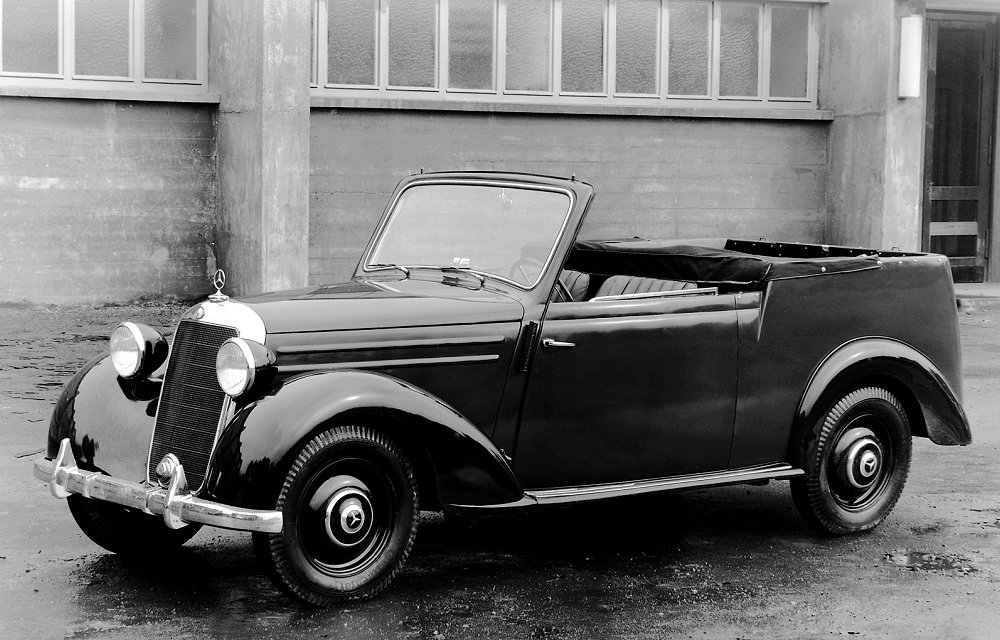
The Mercedes-Benz 170 S Polizei-Streifenwagen was a specialised police patrol version of the 170 S, developed in the late 1940s and early 1950s to serve the needs of German law enforcement during the post-war reconstruction period. Based on the W136 platform, it combined the improved performance and comfort of the 170 S with modifications tailored for police duty, making it a dependable and professional patrol vehicle at a time when rebuilding public order and infrastructure was a national priority.
Power came from the 1.8-litre inline four-cylinder petrol engine used in the standard 170 S, producing approximately 52 horsepower. While modest by later standards, this output provided a useful improvement over the earlier 170 V police vehicles and allowed the Streifenwagen to keep pace with contemporary traffic. The engine was valued for its smooth running, durability and ease of maintenance, all crucial qualities for vehicles expected to operate daily and cover high mileages. A four-speed manual gearbox drove the rear wheels, offering predictable performance and mechanical simplicity.
The chassis retained the robust ladder-frame construction common to the 170 series. Independent front suspension with coil springs gave the police car stable handling and a comparatively comfortable ride, even on damaged or uneven post-war roads. The rear axle used leaf springs tuned to cope with additional equipment and sustained use. Hydraulic drum brakes on all four wheels provided reliable stopping power, an important consideration for patrol and response work in increasingly busy urban environments.
Externally, the Mercedes-Benz 170 S Polizei-Streifenwagen was easily identifiable. It was typically finished in the standard green police livery of the period, often with contrasting wings or panels depending on regional regulations. Roof-mounted blue lights, sirens and external mirrors were fitted as required, along with police insignia and markings. The body was usually based on the saloon configuration, offering a balance between visibility, protection from the elements and secure transport for officers and equipment.
Inside, the interior was functional and adapted for police use. Seating was durable rather than luxurious, and trim materials were chosen for ease of cleaning and longevity. The dashboard remained largely standard but could include additional switches or controls for lighting and siren equipment. Space was allocated for radios, documentation and other essential policing tools, reflecting the increasingly motorised and organised nature of post-war law enforcement.
In service, the 170 S Polizei-Streifenwagen proved to be a reliable and effective patrol car. Its improved performance over earlier models allowed it to respond more quickly to incidents, while its solid road manners and predictable handling made it well suited to both urban patrols and longer regional duties. The car’s understated appearance also conveyed authority and professionalism without intimidation, aligning with the rebuilding of civilian policing in post-war Germany.
The use of the 170 S as a police vehicle highlighted Mercedes-Benz’s close relationship with public services during the company’s recovery years. Supplying dependable vehicles to police forces helped reinforce the brand’s reputation for quality, reliability and engineering integrity at a time when trust and stability were highly valued.
Today, the Mercedes-Benz 170 S Polizei-Streifenwagen is a rare and historically interesting variant of the 170 S range. Surviving examples are prized for their originality and their connection to post-war social history rather than performance or luxury. They serve as tangible reminders of how everyday Mercedes-Benz saloons were adapted to support law enforcement and public order during a crucial period of rebuilding and transition in mid-20th-century Europe.