Description
The Mercedes-Benz 170 V, introduced in 1936, became one of the most important and successful models in the company’s pre-war and post-war history. It replaced the earlier 170 and represented a complete redesign, establishing a new technical foundation for Mercedes’ compact and mid-range vehicles. Highly refined, durable and surprisingly modern in both engineering and construction, the 170 V became the company’s best-selling model of the late 1930s and later played a central role in Mercedes-Benz’s recovery after the Second World War.
At the core of the 170 V was its 1.7-litre inline-four engine, a robust and economical unit producing around 38–45 horsepower depending on year and carburettor specification. Despite modest output, the engine delivered smooth power and reliable torque, making the car suitable for both city work and long-distance touring. It was engineered with durability in mind, using a sturdy cast-iron block, efficient lubrication and simple, proven valve gear. The engine was paired with a four-speed manual gearbox, known for its clean shift action and long service life. Performance was appropriate for the times, with top speeds around 100 km/h and a light, responsive feel at normal driving speeds.
The most significant advancement of the 170 V lay in its entirely new chassis design. Mercedes adopted an X-shaped oval-tube frame, far more rigid and lighter than the earlier ladder frames used on its smaller models. This structure gave the car improved crash resistance, reduced vibration and enhanced stability. The front suspension used independent double wishbones with coil springs, a sophisticated layout usually found only on far more expensive cars. At the rear, the 170 V employed a swing-axle design with coil springs, combining decent ride comfort with predictable handling. For braking, large mechanical drums on all four wheels provided strong and reliable stopping capability.
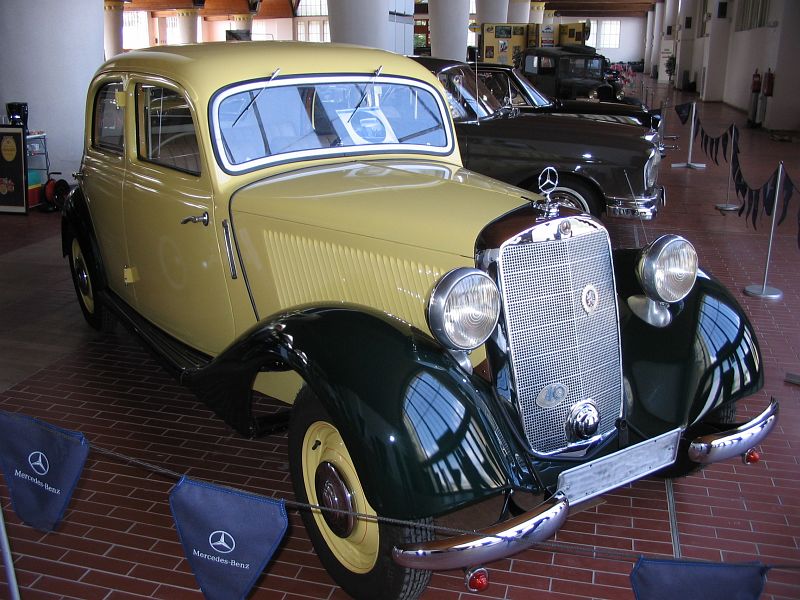
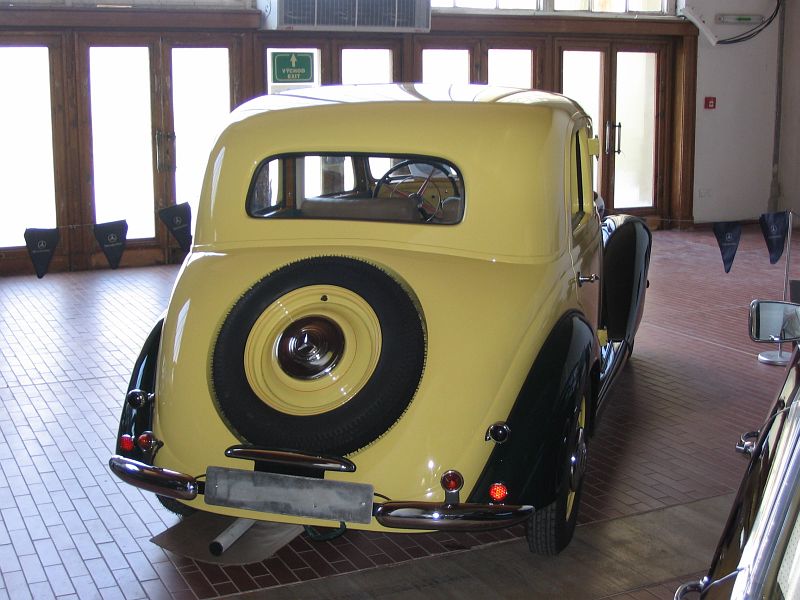
Styling followed the aerodynamic principles emerging in the mid-1930s. The tall, upright grille and separate wings still reflected earlier Mercedes design language, but the body as a whole was lower, more rounded and more streamlined than its predecessor. The proportions were well judged, with a long bonnet, compact cabin and gracefully curved rear section. Despite being an affordable model, the 170 V had the balanced, dignified presence expected of a Mercedes-Benz.
The car was offered in a wide range of body styles to suit different customers and purposes. The most common were the four-door saloon and two- or four-seat cabriolets, all built by Mercedes’ Sindelfingen coachworks. More specialised versions included delivery vans, ambulances, police cars and lightweight commercial variants. The chassis was especially popular among professional drivers and small businesses due to its strength and low running costs. Taxi operators, in particular, valued the 170 V for its reliability, fuel economy and comfortable ride.
Inside, the 170 V combined practicality with careful craftsmanship. The cabin featured upright, supportive seating finished in durable cloth or optional leather. The dashboard used polished wood or painted metal depending on specification, with clear instrumentation including fuel level, oil pressure, speed and temperature. The interior layout emphasised simplicity and easy maintenance while still offering the solid, well-assembled feel associated with the Mercedes name. Good visibility, sensible ergonomics and well-padded seats made the car a comfortable option for long journeys.
On the road, the 170 V delivered a driving experience that felt more refined than many competitors. The independent suspension smoothed out rough surfaces, and the rigid X-frame reduced flex and rattling. Steering was relatively light once moving and offered good accuracy. The engine provided enough power for steady countryside cruising, and the gearbox allowed drivers to make full use of the engine’s torque. The car felt stable, predictable and impressively modern for a late-1930s compact model.
After the war, the 170 V became the first Mercedes-Benz to return to production in 1946. With Germany’s infrastructure in ruins, the car’s practicality, efficiency and durability made it essential for rebuilding public services and commerce. Variants included saloons, vans, pick-ups and ambulances, and thousands were exported to earn vital foreign currency. The model helped re-establish Mercedes-Benz as a manufacturer of high-quality vehicles during a period of enormous difficulty.
Today, the Mercedes-Benz 170 V is appreciated by collectors for its engineering significance, reliability and charm. It represents a turning point in Mercedes history, where advanced chassis design, efficient engineering and practical usability came together in a compact, affordable package. The 170 V was not just a successful model; it became the backbone of the company’s pre-war and post-war survival, leaving a legacy that shaped the development of Mercedes-Benz for decades to come.