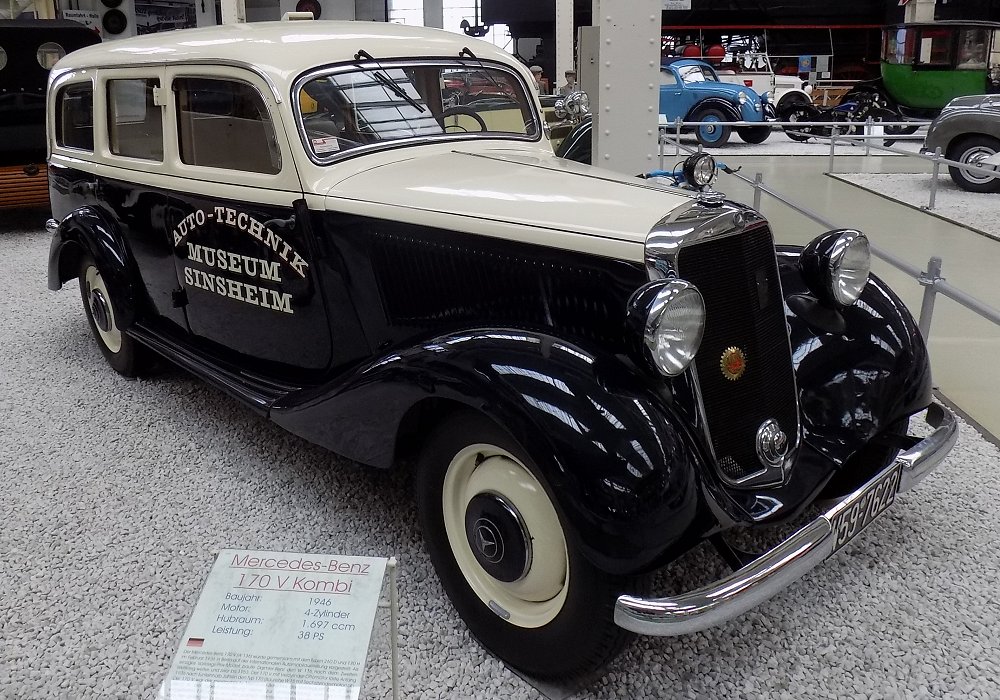
Description
The Mercedes-Benz 170 V Kombi was a practical and versatile derivative of the widely successful 170 V passenger car, developed to meet the growing demand for light commercial and utility vehicles in the late 1930s and immediate post-war years. Based on the W136 platform, the Kombi variant extended the usefulness of the 170 V by combining passenger-car comfort and mechanical refinement with increased load-carrying capacity. It became an important vehicle for tradespeople, small businesses and public services during a period when reliable motor transport was essential to economic recovery.
Power was supplied by the familiar 1.7-litre inline four-cylinder petrol engine used throughout the 170 V range. Producing around 38 horsepower in early form and later increased slightly in post-war versions, the engine was tuned for durability and fuel efficiency rather than performance. Its smooth and predictable power delivery made it well suited to stop-start driving and modest loads. A four-speed manual gearbox transmitted power to the rear wheels, with ratios chosen to balance urban usability and reasonable cruising ability on open roads.
The chassis was a sturdy ladder-frame construction, shared with other 170 V variants, and was well regarded for its strength and reliability. Independent front suspension with coil springs provided a level of ride comfort uncommon in light utility vehicles of the time, while the rear axle used leaf springs designed to cope with increased payload. Hydraulic drum brakes on all four wheels gave dependable stopping power, marking a technical advantage over many contemporary utility vehicles that still relied on mechanical braking systems.
The Kombi body was designed to maximise practicality while retaining a compact footprint. Typically featuring two front doors and a large rear cargo area, it offered flexible accommodation for goods, tools or mixed passenger and load use. The rear section could be fitted with side windows or left panelled, depending on intended use, and rear access was provided by a tailgate or split doors. The overall design was simple and functional, with upright sides and a high roofline that allowed efficient use of interior space.
Inside, the Mercedes-Benz 170 V Kombi was utilitarian but well engineered. The driver’s area closely resembled that of the standard saloon, with clear instrumentation, logical control placement and solid construction. Seating was basic but comfortable enough for long working days, and visibility was good thanks to the upright seating position and large glass area. Interior trim was durable rather than luxurious, reflecting the vehicle’s role as a working tool rather than a private car.
In everyday use, the 170 V Kombi proved to be dependable, economical and easy to maintain. Its relatively small size made it well suited to urban environments, while its robust mechanical components allowed it to cope with poor road surfaces and heavy use. The combination of passenger-car handling and commercial practicality made it especially attractive to small businesses and service operators who needed a vehicle capable of performing multiple roles.
Production of the 170 V Kombi spanned both pre-war and post-war periods, with the model playing a particularly important role in post-war Europe. In the late 1940s and early 1950s, it was widely used by tradesmen, medical services, postal authorities and municipal organisations, contributing to the rebuilding of infrastructure and commerce. Its reputation for reliability helped re-establish Mercedes-Benz as a leading manufacturer during the company’s post-war recovery.
Today, the Mercedes-Benz 170 V Kombi is a rare and historically significant vehicle. Surviving examples are valued for their authenticity and utilitarian charm rather than performance or luxury. They offer insight into a transitional era in automotive history, when manufacturers adapted passenger-car platforms to meet the practical needs of society. As such, the 170 V Kombi stands as an understated but important chapter in the broader legacy of Mercedes-Benz engineering.