Description
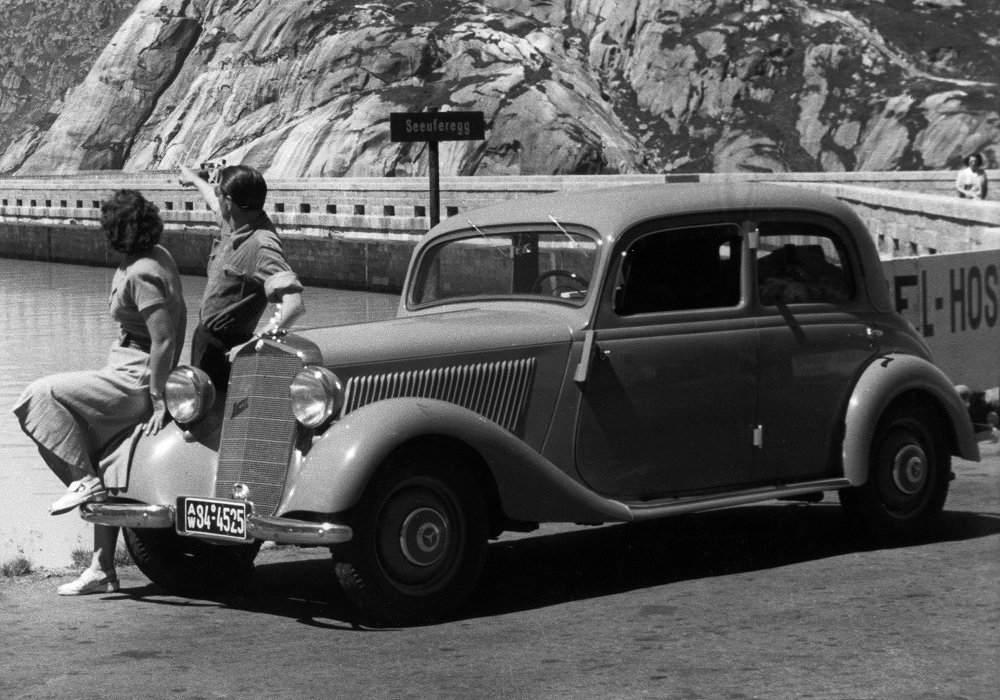
The Mercedes-Benz 170 Va was an updated and refined evolution of the original 170 V, introduced in 1950 as part of Mercedes-Benz’s gradual post-war modernisation programme. Based on the W136 platform, the 170 Va retained the fundamental engineering principles that had made the 170 V so successful before and after the Second World War, but incorporated a series of mechanical and structural improvements aimed at enhancing reliability, drivability and everyday usability. It represented an important transitional step between the immediate post-war models and the more comprehensively updated variants that would follow.
Power for the 170 Va came from a revised version of the familiar 1.7-litre inline four-cylinder petrol engine. Output was modest by modern standards, producing approximately 38 horsepower, but the engine was valued for its smoothness, durability and efficiency rather than outright performance. Improvements in internal components and tuning resulted in more consistent running and better longevity compared with earlier versions. The engine was paired with a four-speed manual gearbox, driving the rear wheels, and offered predictable, easy-to-manage performance well suited to both urban and rural driving conditions.
The chassis of the 170 Va remained a robust ladder-frame design, a hallmark of Mercedes-Benz engineering at the time. Independent front suspension with coil springs continued to provide a comparatively comfortable ride and good road holding, while the rear axle used leaf springs designed to cope with passenger loads and poor road surfaces. One of the most significant upgrades introduced with the Va was the adoption of larger and more effective hydraulic drum brakes, improving stopping performance and safety, particularly in modernising traffic conditions.
Externally, the Mercedes-Benz 170 Va was visually similar to the earlier 170 V, retaining the upright, conservative styling that characterised Mercedes-Benz saloons of the late 1930s and 1940s. The body featured a tall radiator grille, separate front wings and a clean, restrained profile. Subtle detail changes distinguished the Va from its predecessor, but the overall appearance emphasised continuity rather than stylistic innovation. This conservative design appealed to buyers seeking solidity, respectability and understated quality.
Inside, the 170 Va offered a functional and well-constructed interior. Seating was upright and comfortable, trimmed in durable materials appropriate to the car’s role as a practical family and business vehicle. The dashboard layout was straightforward, with clear instrumentation and logically arranged controls. While luxury features were limited, the quality of materials and assembly reflected Mercedes-Benz’s emphasis on long-term durability and precision engineering.
In everyday use, the 170 Va delivered dependable and economical motoring. Its modest performance was offset by smooth power delivery, stable handling and a reputation for mechanical robustness. The car was well suited to the varied driving conditions of post-war Europe, where road quality was often poor and reliability was more important than speed. Owners valued the 170 Va for its low running costs, ease of maintenance and ability to cover high mileages with minimal trouble.
Production of the Mercedes-Benz 170 Va was relatively short-lived, as it served primarily as an interim model. It bridged the gap between the earlier 170 V and the more extensively updated 170 Vb and 170 S variants that introduced further refinements in performance and comfort. Despite its brief production run, the Va played an important role in Mercedes-Benz’s recovery and re-establishment as a leading manufacturer in the early post-war years.
Today, the Mercedes-Benz 170 Va is appreciated as a historically significant model rather than a collector showpiece. Surviving examples are valued for their authenticity and for representing a key stage in the evolution of Mercedes-Benz passenger cars during a period of rebuilding and transition. As such, the 170 Va stands as a quiet but important link between pre-war engineering traditions and the more modern Mercedes-Benz vehicles that would emerge in the 1950s.