Description
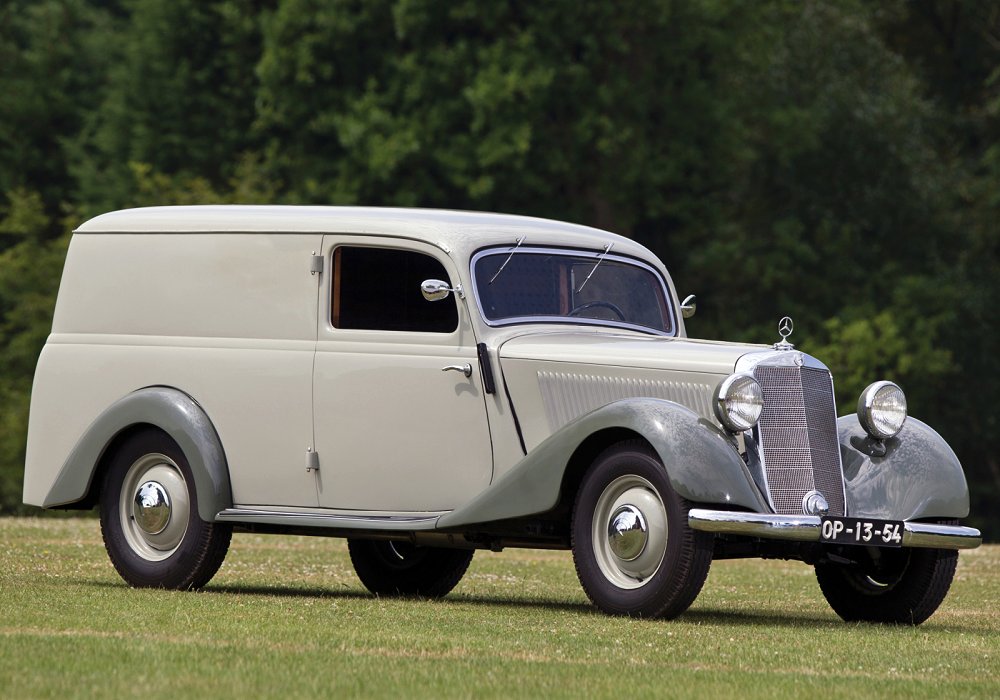
The Mercedes-Benz 170 Va Kasten-Lieferwagen was a closed-panel delivery van variant of the 170 Va, developed in the early post-war period to meet the urgent need for reliable light commercial vehicles. Based on the W136 platform, it combined proven passenger-car engineering with a fully enclosed cargo body, making it especially suitable for tradespeople, small businesses, municipal services and supply operations during the economic reconstruction of the early 1950s. It represented Mercedes-Benz’s pragmatic approach to rebuilding its commercial vehicle lineup using robust, familiar mechanical foundations.
Power was provided by the revised 1.7-litre inline four-cylinder petrol engine shared with the 170 Va saloon. Producing around 38 horsepower, the engine prioritised reliability, fuel efficiency and smooth operation over performance. Its tractable nature made it well suited to frequent stop-start driving and modest payloads. A four-speed manual gearbox transmitted power to the rear wheels, offering dependable operation and straightforward servicing in an era when simplicity and durability were essential.
The chassis was the same ladder-frame construction used across the 170 Va range, valued for its strength and adaptability. Independent front suspension with coil springs gave the Kasten-Lieferwagen a level of ride comfort and steering precision that was uncommon in light commercial vehicles of the time, while the rear axle used reinforced leaf springs to support cargo loads. One of the key improvements of the Va generation was the use of upgraded hydraulic drum brakes, which provided more consistent and effective stopping power under load.
The Kasten-Lieferwagen body was a fully enclosed box-style configuration designed to protect goods from weather and theft. It typically featured two front doors for the cab and a large rear cargo compartment accessed via rear doors. The absence of side windows in the load area improved security and maximised usable wall space for shelving or equipment. The upright body shape allowed efficient use of interior volume, making the van practical for transporting tools, parcels or supplies despite its relatively compact external dimensions.
Inside the cab, the Mercedes-Benz 170 Va Kasten-Lieferwagen was functional and durable. The driving position mirrored that of the saloon model, with clear instrumentation, logically arranged controls and good forward visibility. Seating was simple but comfortable enough for long working days, and interior trim was designed to withstand heavy use rather than provide luxury. The overall impression was of solid, professional-grade construction intended for daily service.
In operation, the 170 Va Kasten-Lieferwagen proved to be dependable and economical. Its modest engine output was sufficient for urban and regional delivery work, and the car-based handling made it easy to drive in narrow streets and confined loading areas. The combination of enclosed cargo space, reliable mechanics and relatively refined road manners made it attractive to businesses transitioning from pre-war vehicles or non-motorised transport.
The model played an important role in post-war Europe, where commercial mobility was essential to economic recovery. Mercedes-Benz supplied these vans to a wide range of users, including tradespeople, postal services, workshops and municipal authorities. Their durability and ease of maintenance helped reinforce the brand’s reputation during a critical period of rebuilding.
Today, the Mercedes-Benz 170 Va Kasten-Lieferwagen is a rare survivor, as most examples were used intensively and eventually worn out in service. Those that remain are valued for their historical significance and understated industrial character. They offer insight into how Mercedes-Benz adapted passenger-car engineering to meet practical commercial needs and stand as representative vehicles of post-war recovery and everyday working life in early 1950s Europe.