Description
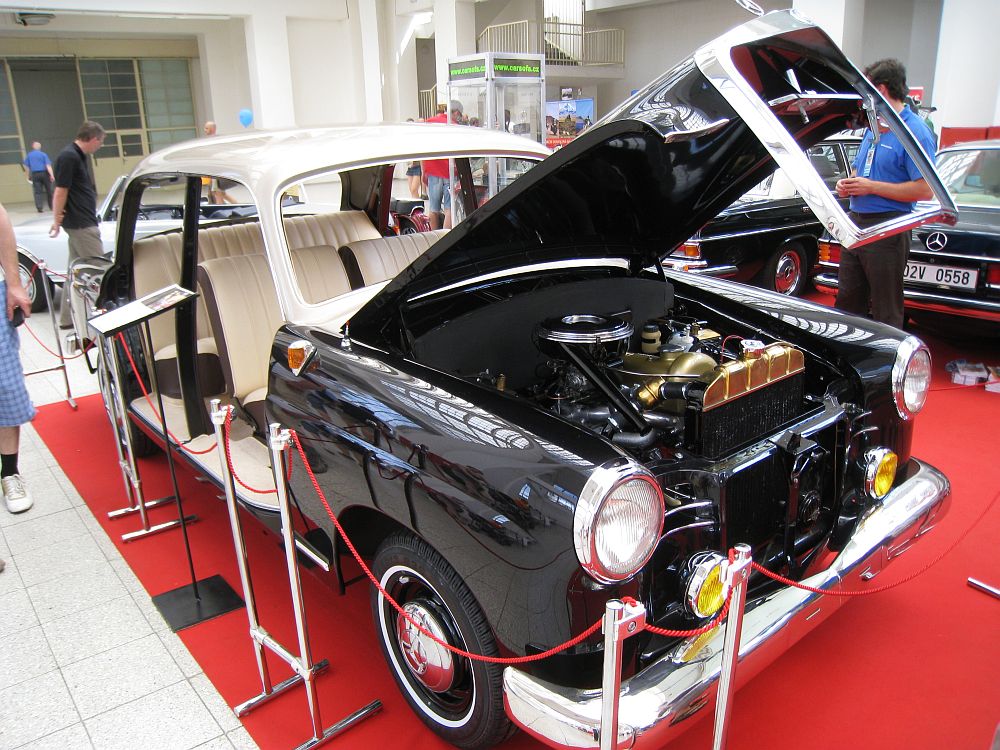
The Mercedes-Benz 190 b was an updated and improved version of the Ponton-series 190, introduced in 1959 as part of Mercedes-Benz’s ongoing refinement of its mid-range saloons. Based on the W121 platform, the 190 b represented the final and most developed iteration of the four-cylinder Ponton models. It combined proven mechanical durability with subtle technical and comfort improvements, offering buyers a well-balanced car that reflected Mercedes-Benz’s conservative but methodical approach to engineering.
Power came from a revised 1.9-litre inline four-cylinder petrol engine. In the 190 b, this unit benefited from improved breathing and carburation, raising output to approximately 80 horsepower. While still not a performance-oriented car, the increased power gave the 190 b better acceleration and more relaxed cruising ability than earlier versions. The engine was smooth and flexible, designed to operate reliably over long distances and extended service intervals. A four-speed manual gearbox transmitted power to the rear wheels, with gearing chosen to suit both urban driving and sustained higher-speed travel.
The 190 b retained the self-supporting monocoque body introduced with the Ponton series, which marked a decisive shift away from the separate chassis designs of pre-war and early post-war Mercedes-Benz models. This construction provided improved rigidity, reduced weight and enhanced occupant safety. Independent front suspension with double wishbones and coil springs delivered predictable handling and good ride comfort, while the rear swing-axle suspension, also coil-sprung, was refined to improve stability and reduce the abrupt handling characteristics sometimes associated with earlier swing-axle designs. Hydraulic drum brakes on all four wheels provided dependable stopping power consistent with the car’s performance.
Externally, the Mercedes-Benz 190 b differed only subtly from earlier Ponton models. The clean, integrated bodywork with fully enclosed wings remained unchanged, maintaining the solid and purposeful appearance that defined Mercedes-Benz styling in the 1950s. Minor detail updates, including trim and lighting changes, distinguished the 190 b from its predecessors. The overall design was understated and conservative, projecting durability and seriousness rather than fashion or sportiness.
Inside, the 190 b offered incremental improvements in comfort and finish. Seating was well padded and supportive, suitable for long-distance travel. Upholstery materials and interior trim were upgraded in quality, reflecting rising expectations as Europe entered a period of greater economic stability. The dashboard layout remained simple and functional, with clear instrumentation and logical control placement. Attention to sound insulation was improved, contributing to a quieter and more refined driving experience than earlier four-cylinder Ponton models.
In everyday use, the Mercedes-Benz 190 b was valued for its balance of reliability, comfort and adequate performance. The slightly more powerful engine made it better suited to motorway driving, while the refined suspension and solid body structure gave it stable and predictable road manners. It was a car that rewarded smooth, unhurried driving and excelled in covering long distances with minimal mechanical stress.
The 190 b arrived at the end of the Ponton era, shortly before Mercedes-Benz introduced the more modern “Fintail” saloons of the early 1960s. As such, it represents the culmination of a design philosophy rooted in post-war conservatism and engineering pragmatism. It carried forward many traditional Mercedes-Benz values while benefiting from a decade of steady technical evolution.
Today, the Mercedes-Benz 190 b is appreciated as the most refined four-cylinder Ponton model. Surviving examples are valued for their usability, mechanical robustness and historical significance rather than rarity or outright performance. As the final development of the W121 series, the 190 b stands as a fitting conclusion to the first generation of modern Mercedes-Benz monocoque saloons and a clear illustration of the brand’s disciplined approach to continuous improvement.