Description
The Mercedes-Benz 200 in 1975 belonged to the W115 series and represented one of the final evolutions of Mercedes-Benz’s four-cylinder mid-size saloons before the introduction of the W123. By this point, the W114/W115 range was fully mature, and the 200 embodied the brand’s core values of durability, safety and understated comfort. It was positioned as an entry-level petrol model, but still delivered the same fundamental engineering integrity as its more powerful six-cylinder counterparts.
Power came from a 2.0-litre inline four-cylinder petrol engine from the M115 family, producing approximately 95 horsepower. This engine was tuned for smoothness, reliability and long service life rather than outright performance. Acceleration was steady rather than brisk, but the car was well capable of sustained motorway cruising, especially when driven in a relaxed manner. A four-speed manual gearbox was standard, with an automatic transmission available for buyers who prioritised ease of use and comfort.
The chassis was based on Mercedes-Benz’s robust unitary body construction, featuring a strong passenger safety cell and engineered front and rear crumple zones. Suspension consisted of double wishbones with coil springs at the front and a rear semi-trailing arm setup with coil springs, a configuration that offered predictable handling and good stability compared with earlier swing-axle designs. Front disc brakes and rear drum brakes provided dependable stopping power, well matched to the car’s modest performance.
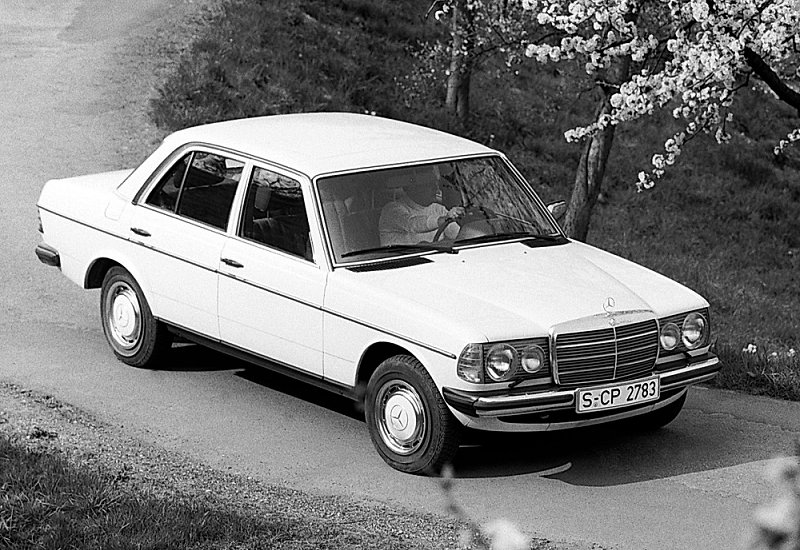
Styling of the 1975 Mercedes-Benz 200 reflected the clean, functional design language of the W115 series. Straight body lines, a large glass area and an upright grille gave the car a professional and timeless appearance. Chrome detailing was restrained, and the overall design emphasised clarity and solidity rather than fashion. Compared with earlier fintail models, the W115 looked more modern and international, yet remained unmistakably Mercedes-Benz.
Inside, the cabin was spacious, practical and built to withstand years of use. Seats were upright and supportive, trimmed in hard-wearing materials chosen for longevity rather than luxury. The dashboard layout was simple and logical, with clear instrumentation and excellent visibility. Build quality was a standout feature, with solid switchgear and durable interior fittings that contributed to the car’s reputation for long-term reliability.
In everyday driving, the Mercedes-Benz 200 rewarded smooth, unhurried operation. It was not a car for rapid acceleration or aggressive driving, but it excelled in steady traffic and long-distance use. Steering was accurate but relatively heavy at low speeds, and the suspension provided a comfortable ride even on poor road surfaces. Owners valued its predictability, mechanical honesty and ease of maintenance.
By 1975, the 200 had become a familiar sight across Europe, commonly used by families, professionals and fleet operators. Its relatively simple mechanical layout made it dependable and economical to own, while its conservative styling and solid construction ensured it aged gracefully. Many examples accumulated high mileages, reinforcing Mercedes-Benz’s reputation for building cars designed to last.
Today, the 1975 Mercedes-Benz 200 is appreciated as a representative example of late W115 engineering. It stands at the end of an era, just before the arrival of the legendary W123, and reflects Mercedes-Benz’s methodical approach to refinement rather than reinvention. Valued for its durability, understated design and historical context, the Mercedes-Benz 200 from 1975 remains a respected and authentic classic of the brand’s mid-size saloon lineage.