Description
The Mercedes-Benz 200 D was the diesel variant of the W110 “Fintail” series and represented Mercedes-Benz’s continued commitment to diesel-powered passenger cars during the 1960s. At a time when diesel engines were still uncommon in private saloons, the 200 D reinforced Mercedes-Benz’s reputation for durability, economy and engineering foresight. It was aimed primarily at professional users and high-mileage drivers, but it also found favour with private owners who valued reliability over performance.
Power came from a 2.0-litre inline four-cylinder diesel engine, producing approximately 55 horsepower. While acceleration was modest, the engine delivered strong low-speed torque and exceptional fuel economy for the period. The diesel unit was renowned for its robustness and ability to cover very high mileages with minimal mechanical wear, making it especially popular as a taxi and long-distance workhorse. A four-speed manual gearbox drove the rear wheels, with gearing chosen to suit steady cruising rather than speed.
The Mercedes-Benz 200 D used the same unitary body structure as its petrol counterpart. Suspension consisted of double wishbones with coil springs at the front and Mercedes-Benz’s improved low-pivot swing axle with coil springs at the rear. This rear suspension design significantly enhanced stability compared with earlier swing-axle layouts and reduced the risk of sudden oversteer. Front disc brakes and rear drum brakes provided dependable stopping performance, well matched to the car’s modest power output.
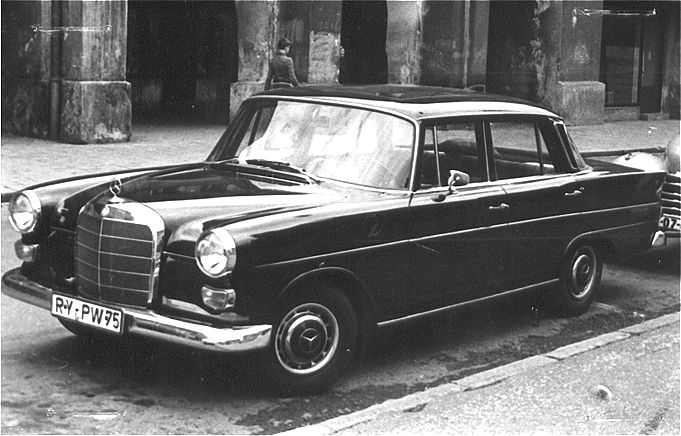
Externally, the 200 D was almost identical to the petrol 200. It featured the restrained fintail styling that defined the W110 series, with small tailfins designed more for visibility than decoration. The upright grille, clean body lines and conservative chrome detailing gave the car a dignified and professional appearance. Diesel badging was subtle, reflecting Mercedes-Benz’s philosophy that diesel ownership should not come with a visual compromise.
Inside, the cabin was functional, spacious and built for longevity. Seating was upright and supportive, trimmed in durable materials intended to withstand years of heavy use. The dashboard was simple and logical, with clear instrumentation and excellent visibility. Compared with petrol models, the diesel version was noisier and more vibration-prone, particularly at idle, but this was widely accepted as the trade-off for superior economy and longevity.
In everyday driving, the Mercedes-Benz 200 D was slow but dependable. It excelled at steady cruising and long-distance operation rather than urban acceleration. The car rewarded smooth driving and mechanical sympathy, and its predictable handling and stable ride made it well suited to poor road conditions. Owners valued its ability to operate reliably day after day with low fuel consumption and minimal servicing requirements.
The 200 D played an important role in cementing Mercedes-Benz’s leadership in diesel passenger cars. By offering diesel power in a comfortable, well-engineered saloon, Mercedes-Benz demonstrated that diesel engines were not solely for commercial vehicles. This philosophy would continue to shape the brand’s identity for decades.
Today, the 1965 Mercedes-Benz 200 D is appreciated for its historical significance rather than performance. Surviving examples are valued for their mechanical honesty, durability and connection to an era when Mercedes-Benz engineering prioritised longevity above all else. As one of the definitive diesel saloons of the 1960s, the 200 D stands as a testament to Mercedes-Benz’s early mastery of passenger-car diesel technology and its lasting influence on the automotive world.