Description
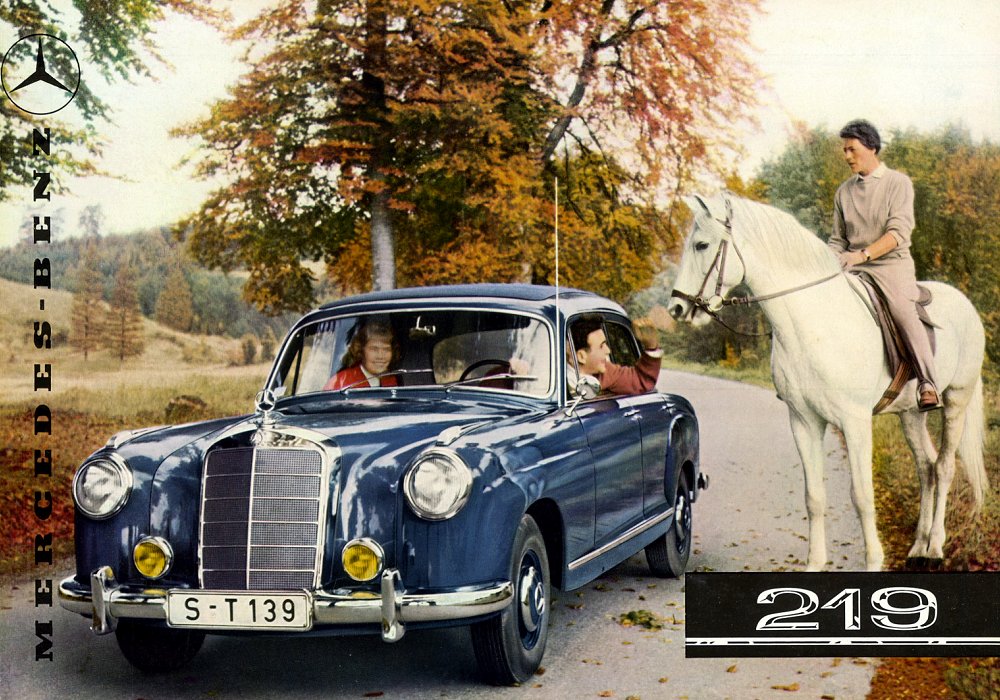
The Mercedes-Benz 219 was a short-lived but technically and stylistically interesting model that sat between two generations of Mercedes-Benz design philosophy. Introduced in 1956 under the internal designation W105, the 219 combined the modern ponton body structure of the W120/W121 series with the more powerful six-cylinder engine from the earlier W187 220. It was conceived as an interim solution, offering enhanced performance within an existing body shell while Mercedes-Benz prepared its next fully updated model range.
Power for the Mercedes-Benz 219 came from a 2.2-litre inline six-cylinder petrol engine derived from the W187 220. Producing approximately 85 horsepower, this engine gave the 219 a clear performance advantage over the four-cylinder 180 and 190 models. The six-cylinder unit delivered smooth, refined power with improved acceleration and higher cruising speeds, making the 219 particularly well suited to autobahn driving and long-distance touring. A four-speed manual gearbox transmitted power to the rear wheels, with ratios chosen to balance flexibility and relaxed cruising.
Structurally, the 219 used the self-supporting monocoque body of the Ponton series, a key step in Mercedes-Benz’s post-war modernisation. This unitary construction improved rigidity, reduced weight and enhanced safety compared with earlier ladder-frame designs. Independent front suspension with double wishbones and coil springs provided stable and predictable handling, while the rear swing-axle suspension with coil springs delivered a comfortable ride by the standards of the time. Hydraulic drum brakes on all four wheels offered reliable stopping performance consistent with the car’s increased power.
Visually, the Mercedes-Benz 219 was almost indistinguishable from the four-cylinder Ponton models. It retained the clean, integrated body shape with fully enclosed wings, upright grille and restrained chrome detailing that defined Mercedes-Benz styling in the mid-1950s. This understated appearance masked the car’s more capable mechanical specification, making the 219 a discreet performer rather than an overtly sporting saloon.
Inside, the cabin closely resembled that of the 180 and 190, with practical, well-constructed seating and a straightforward dashboard layout. Materials were durable and functional, reflecting Mercedes-Benz’s emphasis on longevity and quality rather than luxury embellishment. While interior space and comfort were good, the main distinction of the 219 lay in its smoother and quieter six-cylinder power delivery rather than any major changes to trim or equipment.
In everyday use, the Mercedes-Benz 219 offered a notably more refined driving experience than its four-cylinder siblings. The six-cylinder engine reduced vibration and noise, particularly at cruising speeds, and made the car feel more relaxed on longer journeys. Handling remained predictable and conservative, and the car rewarded smooth, measured driving. Fuel consumption was higher than in the four-cylinder models, but many buyers accepted this trade-off for the improved performance and refinement.
Production of the Mercedes-Benz 219 was limited, as the model existed only briefly before being superseded by more modern designs. Its role as a transitional vehicle meant it was never produced in large numbers, and it was quickly overshadowed by the introduction of the “Fintail” saloons at the end of the 1950s. As a result, the 219 remained relatively obscure even during its own time.
Today, the Mercedes-Benz 219 is regarded as a rare and interesting footnote in Mercedes-Benz history. It represents a pragmatic engineering solution, combining existing components to meet market demand while a new generation was under development. Surviving examples are valued for their smooth six-cylinder engines, Ponton-era build quality and historical significance. As such, the 219 stands as a quiet but important link between Mercedes-Benz’s first modern monocoque saloons and the more advanced models that would soon follow.