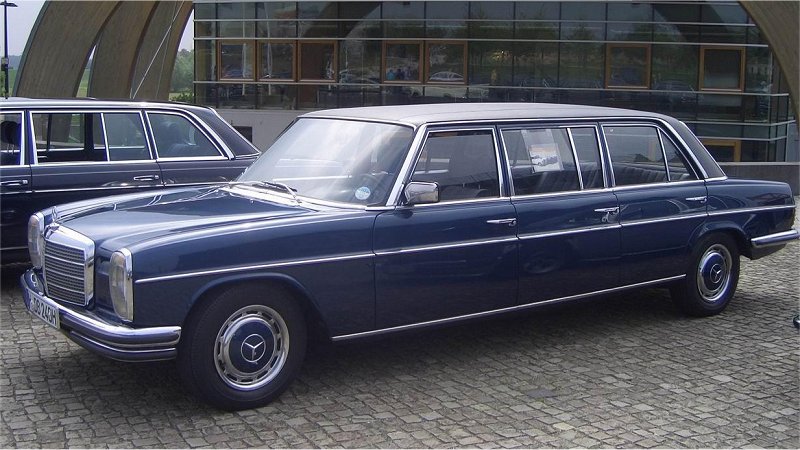
Description
The Mercedes-Benz 230 Lang was the long-wheelbase version of the W143 230, produced in the late 1930s as a more spacious and prestigious alternative to the standard saloon. The designation “Lang,” meaning long, referred to the extended wheelbase that allowed increased rear passenger accommodation, making the car particularly suitable for chauffeur-driven use, official duties and customers who valued comfort over compactness. It sat within Mercedes-Benz’s pre-war mid-range luxury lineup, bridging the gap between everyday saloons and the company’s larger and more expensive models.
Power came from a 2.2-litre inline six-cylinder petrol engine, producing approximately 55 horsepower. While not intended to be fast, the engine was smooth and flexible, delivering power in a refined and predictable manner. Its character was well matched to the 230 Lang’s role as a dignified touring and town car rather than a sporting vehicle. A four-speed manual gearbox transmitted power to the rear wheels, with ratios chosen to provide relaxed progress and mechanical longevity.
The chassis was a traditional ladder-frame construction, extended to accommodate the longer wheelbase. This design provided excellent structural strength and ride stability, particularly important for a car expected to carry rear passengers in comfort. Suspension consisted of independent front suspension with transverse leaf springs and a rear live axle with leaf springs, a layout typical of Mercedes-Benz designs of the period. Hydraulic brakes on all four wheels provided reliable stopping power, reflecting the company’s advanced approach to safety for the time.
Externally, the Mercedes-Benz 230 Lang closely resembled the standard 230 saloon but with subtly altered proportions. The extended rear doors and longer body gave the car a more formal and stately appearance. Styling was conservative and elegant, with flowing wings, an upright radiator grille and restrained chrome detailing. Coachbuilt variations were also available, including limousines and special-purpose bodies, depending on customer requirements and market.
Inside, the key advantage of the 230 Lang was rear-seat comfort. The longer wheelbase allowed increased legroom, making the rear compartment suitable for senior officials, business leaders or families who preferred to travel in the back. Interiors were trimmed in high-quality cloth or leather, depending on specification, and attention was paid to quietness and ride comfort. The driving position was upright and commanding, with clear instrumentation and solid controls typical of Mercedes-Benz craftsmanship in the late 1930s.
In use, the 230 Lang was valued for its smooth ride and refined manners. The longer wheelbase improved straight-line stability and ride quality, particularly on uneven road surfaces. While acceleration was modest, the car excelled at steady cruising and urban driving, where its smooth engine and predictable handling made it easy to operate. It was especially well suited to chauffeur-driven service, where comfort and dignity were more important than speed.
Production of the Mercedes-Benz 230 Lang was limited compared with the standard 230, as it catered to a narrower audience. Many examples were used by officials, professional drivers and institutions, and some were later lost during the upheavals of the Second World War. As a result, surviving cars are relatively rare today.
In retrospect, the Mercedes-Benz 230 Lang represents Mercedes-Benz’s long-standing tradition of offering extended-wheelbase versions for customers who prioritised comfort and prestige. It illustrates the company’s pre-war design philosophy, where mechanical refinement, conservative styling and adaptability to customer needs defined the brand. Today, the 230 Lang is appreciated as an elegant and historically significant example of Mercedes-Benz luxury motoring on the eve of the Second World War.