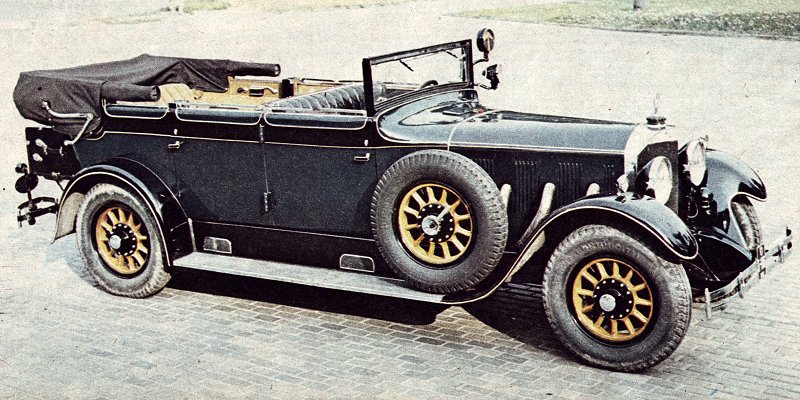
Description
The Mercedes-Benz 24/100/140 PS was one of the most advanced and prestigious German performance cars of the early 1920s, sitting at the top of Mercedes’ pre-Daimler–Benz-merger lineup before the company transitioned into its later, better-known S, SS and SSK supercharged sports models. It exemplified the engineering philosophy that would soon make Mercedes a dominant force in both luxury motoring and high-performance automobile design: robust construction, sophisticated mechanical tuning and the early mastery of supercharging.
The model’s name followed the contemporary German convention: 24 tax horsepower for registration purposes, 100 horsepower in normal aspirated running and up to 140 horsepower with the mechanical supercharger engaged. This flexible power output made the 24/100/140 PS one of the fastest and most capable touring cars of its time, placing it among the absolute elite of early 1920s performance motoring.
At its heart was a large 6.3-litre inline-six engine, a substantial unit designed for strong torque delivery and effortless long-distance travel. The defining feature was the Mercedes-developed Roots-type supercharger, mechanically driven and automatically engaged when the driver fully depressed the throttle. When activated, the Kompressor forced pressurised air into the cylinders, transforming the car’s performance with a sudden and dramatic surge of power. This technology—still in its infancy—was pioneered by Mercedes and became one of the company’s most important engineering trademarks throughout the decade.
The chassis employed Mercedes’ characteristic ladder-frame construction, made from strong steel sections that gave the large car stability and durability. Suspension used semi-elliptic leaf springs at all four corners, providing a firm but controlled ride suitable for both smooth roads and the less predictable surfaces of the early 20th century. Four-wheel brakes were fitted, a highly progressive feature for the era, offering the car strong and reliable stopping performance despite its size and weight. Steering was mechanical and direct, requiring effort at low speeds but providing excellent feedback once underway.
The 24/100/140 PS was offered in a wide variety of body styles, typically crafted by Europe’s most respected coachbuilders. Popular configurations included touring cars, phaetons, limousines and elegant cabriolets. These bodies were characterised by long, imposing bonnets, upright radiators, generous wheelbases and luxurious passenger accommodation. The car balanced refined appearance with confident sporting posture, enhanced by its large wheels, purposeful stance and the prominent exhaust system associated with the supercharged Mercedes models of the period.
Inside, the car offered the level of comfort expected of a top-tier luxury automobile. Cabins were finished with fine woods, leather upholstery and polished metal fittings. Instrumentation was thorough and neatly arranged, including the traditional Mercedes gauges for speed, oil pressure and coolant temperature, as well as the indicator for Kompressor operation. Although not designed as a pure sports car, the 24/100/140 PS retained a sense of mechanical engagement, with a large steering wheel, long gear lever and a driving position that conveyed the seriousness of its performance.
On the road, the car delivered an exceptional blend of refinement and power. Without the supercharger engaged, it behaved as a smooth, torque-rich grand tourer capable of relaxed and comfortable travel. When the Kompressor came into play, it transformed into a formidable machine with rapid acceleration and impressive high-speed capability. Its strong chassis, effective brakes and confident road manners allowed it to cover long distances with ease, making it particularly suited to long-range Continental touring.
The 24/100/140 PS also played an important role in motorsport history. It served as the engineering basis for later performance developments and contributed directly to the lineage that produced the legendary Mercedes S, SS and SSK series. These cars would go on to dominate hillclimbs and road races throughout the late 1920s, but the roots of their success lay in the design principles first refined in the 24/100/140 PS.
Today, the Mercedes-Benz 24/100/140 PS is regarded as one of the most significant early supercharged luxury performance cars. It represents a turning point in Mercedes engineering, a milestone in the use of forced induction and a symbol of the marque’s transition from early prestige automobiles to the high-performance giants that would define the brand’s golden era. Surviving examples are rare and extremely valuable, cherished for their mechanical sophistication, historical importance and imposing presence.