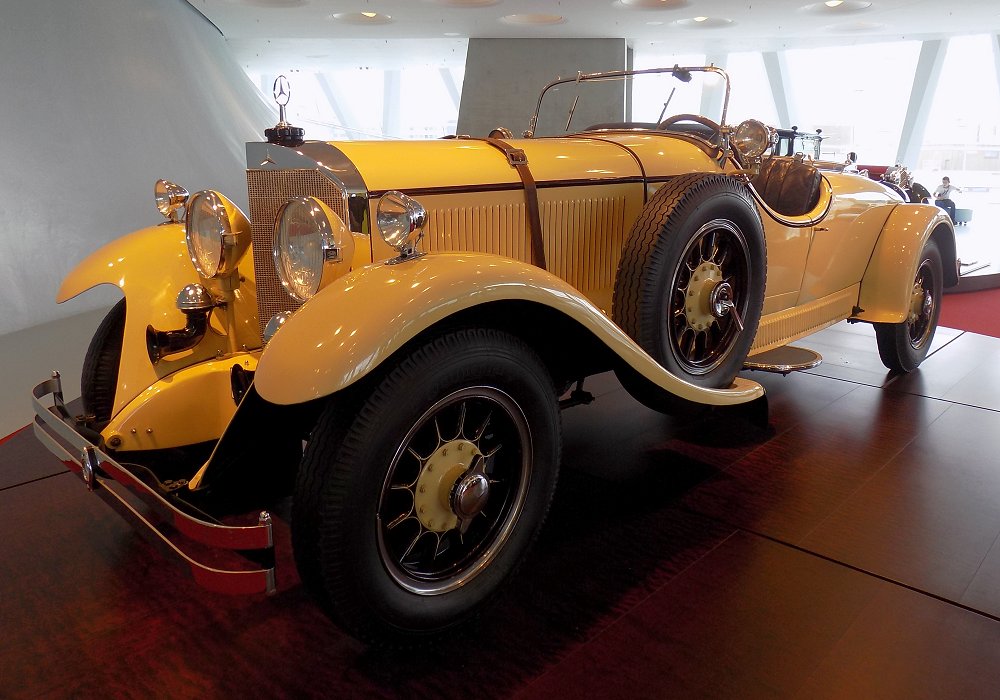
Description
The Mercedes-Benz 24/100/140 PS Roadster was one of the most exclusive and sporting variants of Mercedes’ flagship supercharged model of the early 1920s. While the 24/100/140 PS chassis was often fitted with large touring or limousine bodies, the Roadster configuration transformed it into a lighter, more dynamic and visually dramatic machine, aimed at enthusiastic drivers who wanted the performance of Mercedes’ powerful Kompressor engine combined with a sporting open-body design. This model served as a direct precursor to the legendary S-, SS- and SSK-series sports cars that would follow later in the decade.
As with all versions of the 24/100/140 PS, the Roadster was powered by a 6.3-litre inline-six engine equipped with a Mercedes mechanical supercharger. The model designation reflected its power output: 24 tax horsepower, 100 horsepower in normal operation and up to around 140 horsepower when the Kompressor was engaged. Activation occurred via a mechanical clutch system linked to the accelerator pedal—wide-open throttle would engage the blower with a sudden surge of pressurised air into the cylinders. On the open road, this translated into vigorous acceleration and a dramatic change in engine tone, making the Roadster an exciting driver’s machine at a time when few road cars offered similar performance.
The chassis was the same strong ladder-frame design used across the 24/100/140 PS range, built for durability, stability and long-distance capability. Semi-elliptic leaf springs front and rear provided a balanced ride, combining firmness with enough compliance for uneven early-20th-century road surfaces. Four-wheel drum brakes gave the car stopping performance well above the standards of its era, offering reassuring feedback even during spirited driving. Steering was mechanical, weighty at low speeds but confidence-inspiring at cruising and sporting speeds.
The Roadster body style brought a different character to the platform. It featured a low, elegant two-seat open-top design, with a long bonnet, upright radiator and flowing front wings typical of Mercedes’ high-performance models of the era. Coachbuilders often crafted these bodies with minimal weather equipment—typically a folding canvas top and detachable side screens—prioritising weight savings and sporting aesthetics. The short rear deck, exposed spare wheel and clean side profile emphasised the car’s athletic intentions. While heavier touring variants conveyed luxury and prestige, the Roadster carried a sense of agility and purposeful performance.
Inside, the Roadster’s cabin was more focused and driver-oriented than the larger touring bodies. The cockpit typically featured twin bucket-style seats trimmed in leather, a simple dashboard with essential instruments—speedometer, oil pressure, coolant temperature and supercharger indicator—and a large steering wheel mounted at an angle that suited enthusiastic driving. The long gear lever and exposed mechanical linkages added to the tactile, mechanical feel that defined the model.
On the road, the 24/100/140 PS Roadster delivered exhilarating performance for its time. Without supercharger assistance, it functioned as a smooth and torque-rich grand touring car. When the Kompressor engaged, however, it became significantly more assertive, with strong mid-range acceleration and a top speed placing it comfortably among the fastest road-legal cars of the early 1920s. Its lighter body weight improved handling and responsiveness compared with the heavier tourers, making the Roadster particularly suited to spirited driving on winding roads or mountain passes.
The engineering principles refined in the 24/100/140 PS Roadster directly influenced Mercedes’ later performance icons. The combination of a powerful supercharged inline-six, strong ladder-frame chassis and lightweight sporting body would evolve into the legendary S-Type series of the late 1920s—cars that dominated hillclimbs, endurance races and road events throughout Europe. The Roadster therefore occupies an important place in Mercedes’ development story, acting as a bridge between stately luxury models and purebred sports-racing machines.
Today, the Mercedes-Benz 24/100/140 PS Roadster is considered one of the most desirable variants of the early Kompressor era. Rare, mechanically impressive and historically important, surviving examples are highly valued for their elegance, their engineering significance and the captivating mix of luxury and sporting character they represent.