Description
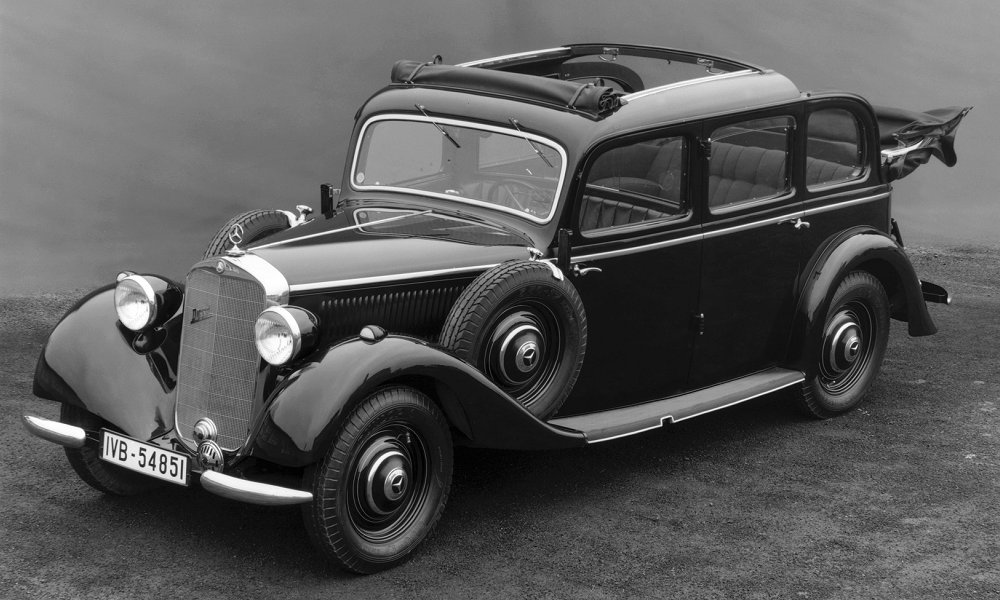
The Mercedes-Benz 260 D Landaulet was one of the most historically significant body styles ever built on the world’s first series-production diesel passenger car. Introduced in 1936 as part of the W138 range, the 260 D Landaulet combined the robust efficiency of Mercedes’ pioneering diesel engine with the formal, chauffeur-orientated elegance of the landaulet body style. It was aimed primarily at official fleets, government bodies, taxi operators and institutions that required economical running, exceptional durability and the prestige of a Mercedes-Benz. The result was a uniquely practical yet ceremonially appropriate vehicle that played an important role in pre-war and early post-war transport.
At the heart of the 260 D Landaulet was Mercedes-Benz’s groundbreaking 2.6-litre OM138 diesel engine, a four-cylinder unit producing around 45 horsepower. Though modest in output, the engine was renowned for its extraordinary fuel economy, longevity and consistent torque. It was designed to run reliably for vast mileages with low operating costs, attributes that made diesel propulsion an attractive option for commercial users. With its characteristic slow-revving smoothness and deep torque delivery, the OM138 gave the Landaulet a relaxed, steady manner on the road. The engine was paired with a four-speed manual gearbox whose gearing was tailored to extract the most from the diesel’s torque curve. While acceleration was not brisk, the car excelled in dependable, economical long-distance use.
The chassis used the W138’s sturdy and elongated frame, designed to accommodate both the heavier diesel engine and the specialised landaulet bodywork. The long wheelbase gave the car a spacious rear compartment and a stable, comfortable ride that was well suited to formal passenger transport. Semi-elliptic leaf springs front and rear delivered a supple, controlled ride at typical touring speeds. Mechanical drum brakes on all four wheels provided reliable stopping power, and the steering, though heavy at low speeds, offered predictable handling once the car was underway. The Landaulet was not a sporting machine, but it was exceptionally well suited to steady, dignified driving in both city and long-route service.
The bodywork of the 260 D Landaulet was crafted to serve dual purposes. The front compartment, occupied by the driver and occasionally a front passenger, was fully enclosed, providing protection and comfort for the chauffeur. The rear compartment, accessed through wide doors, featured seating for dignitaries, officials or paying passengers, depending on the car’s service role. The defining feature was the folding rear roof section: a large canvas top that could be opened to expose the rear seats while leaving the chauffeur’s compartment covered. This configuration made the Landaulet ideal for public appearances, processions, hotel and station service, or warm-weather ceremonial use.
Visually, the car had a dignified, slightly formal presence. The tall Mercedes radiator grille, sweeping wings and long, straight body lines conveyed authority and solidity. The balanced proportions and gracefully integrated folding roof gave the car both formality and flexibility. Sindelfingen craftsmanship ensured precise panel fit, quality materials and robust durability—essential qualities for a vehicle expected to endure heavy daily use. Interior appointments varied according to specification, but rear compartments often featured well-padded seats, durable upholstery and simple but well-finished trim. The emphasis was on comfort, practicality and professional presentation rather than overt luxury.
On the road, the Mercedes-Benz 260 D Landaulet delivered a smooth, economical and consistent driving experience. The diesel engine excelled in steady-speed cruising, and the long wheelbase provided a calm, rolling ride that rear passengers found particularly comfortable. With the roof open, the rear compartment offered excellent visibility and ventilation, making processional travel enjoyable. With the roof closed, the car remained weatherproof and well insulated. In city taxi service, the diesel engine’s low fuel consumption made the Landaulet especially cost-effective, while the dignified appearance lent an air of prestige to fleets and official services.
The 260 D Landaulet played a significant role in public transportation, government service and institutional fleets. It was especially favoured by hotels, railway companies, state officials and taxi operators who valued its low running costs, durable mechanicals and adaptable body style. Its pioneering diesel technology laid the foundation for the decades-long dominance of Mercedes-Benz diesel engines in taxis and utility vehicles across the world.
Today, the Mercedes-Benz 260 D Landaulet is regarded as one of the most historically important early Mercedes models. Survivors are exceedingly rare, as most examples saw heavy professional use over many years. Collectors value the car for its pioneering diesel heritage, its unusual landaulet configuration and its connection to the formative era of modern commercial motoring. As both a technical milestone and a symbol of pre-war Mercedes versatility, the 260 D Landaulet remains an evocative and highly significant piece of automotive history.