
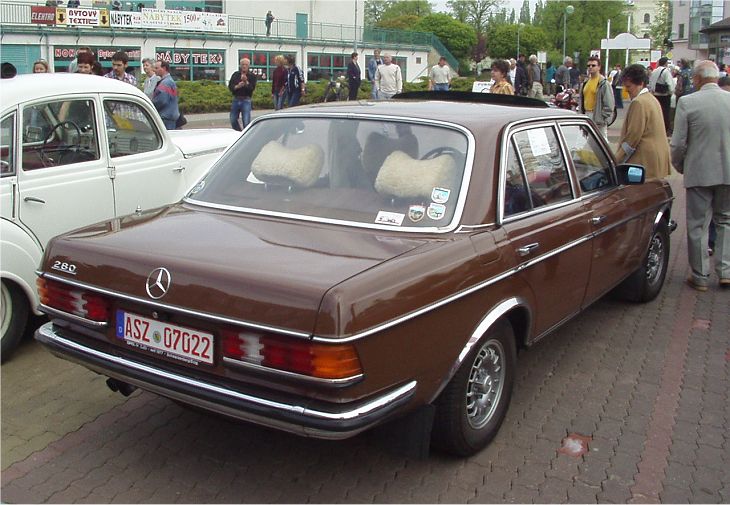
Description
The Mercedes-Benz 280 was one of the most refined and capable six-cylinder models produced by Mercedes-Benz during the late 1960s and 1970s, sitting near the top of the company’s mid-size range. Offered primarily within the W114/W115 series, and later echoed in the early W123 lineup, the 280 was designed for buyers who wanted strong performance, smoothness and prestige without stepping up to the larger S-Class. It represented the point at which executive comfort and genuine performance met in a discreet, understated package.
Power came from a 2.8-litre inline six-cylinder petrol engine, available in both carburetted and fuel-injected forms depending on year and market. Output ranged from around 140 horsepower in earlier versions to approximately 160 horsepower in injected variants. This engine was notable for its smoothness, strong mid-range torque and quiet operation, giving the 280 a level of refinement that clearly distinguished it from four-cylinder models. Acceleration was brisk for the period, and high-speed cruising was effortless, making the car particularly well suited to motorway and autobahn use. Manual and automatic transmissions were offered, with the automatic especially popular among buyers seeking maximum comfort.
The chassis was based on Mercedes-Benz’s robust unitary construction, featuring a strong passenger safety cell and engineered crumple zones, reflecting the brand’s leadership in passive safety. Suspension consisted of double wishbones with coil springs at the front and a rear semi-trailing arm layout with coil springs, providing predictable handling and excellent ride comfort. Disc brakes were fitted at all four wheels, ensuring confident stopping power that matched the car’s performance capabilities.
Styling of the Mercedes-Benz 280 followed the clean, restrained design language that defined Mercedes-Benz during this era. Straight body lines, an upright grille and generous glass areas gave the car a dignified, timeless appearance. Chrome detailing was subtle and purposeful rather than decorative, reinforcing the car’s professional and understated character. Whether in saloon or coupé form, the 280 projected authority and quality without drawing unnecessary attention.
Inside, the cabin was spacious, solidly constructed and designed for long-distance comfort. Seating was upright and supportive, trimmed in durable materials intended to withstand years of use. Higher specifications often included upgraded upholstery, wood trim and additional convenience features, but even base versions conveyed a sense of quality through excellent fit and finish. The dashboard layout was logical and uncluttered, with clear instrumentation and excellent visibility, underscoring Mercedes-Benz’s emphasis on ergonomics.
On the road, the Mercedes-Benz 280 delivered a calm and assured driving experience. The six-cylinder engine provided smooth, flexible power, while the suspension absorbed road imperfections with ease. Handling was stable and predictable, favouring comfort and confidence over sharp responses. The car encouraged smooth, unhurried driving and excelled at covering long distances with minimal fatigue.
The 280 was popular with professionals, executives and private owners who valued refinement and performance in equal measure. It was widely respected for its mechanical robustness and ability to accumulate high mileages when properly maintained. In many markets, it was seen as the ideal balance between everyday usability and luxury.
Today, the Mercedes-Benz 280 is regarded as one of the most complete and desirable classic Mercedes saloons of its era. It is valued for its smooth six-cylinder engine, solid construction and timeless design. As a model that embodied Mercedes-Benz’s philosophy of engineering-led refinement, the 280 remains a strong symbol of a period when quality, durability and understated performance defined the brand’s identity.