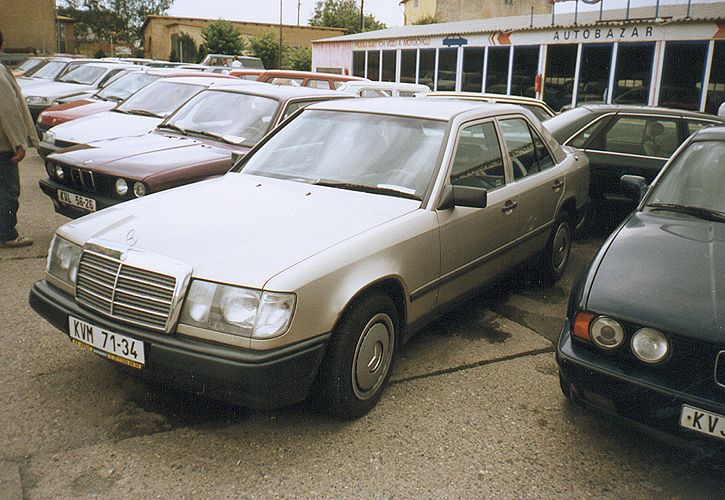
Description
The Mercedes-Benz 300 E was a key model in Mercedes-Benz’s transition from the traditional, durability-focused era of the W123 to the more modern, performance-oriented philosophy embodied by the W124. Introduced in the mid-1980s, the 300 E combined advanced engine technology, improved aerodynamics and a high level of comfort, while still retaining the engineering solidity and long-term reliability for which the brand was known. It quickly established itself as one of the most balanced executive saloons of its time.
Power came from a 3.0-litre inline six-cylinder petrol engine with fuel injection. Early versions produced around 180 horsepower, giving the 300 E strong performance by contemporary standards. Acceleration was brisk, and high-speed cruising was effortless, particularly on motorways. The engine was smooth, flexible and notably quieter than earlier six-cylinder units, reflecting advances in engine design and refinement. Buyers could choose between a five-speed manual gearbox and a four-speed automatic transmission, with the automatic being the more popular option due to its relaxed and refined character.
The W124 platform marked a significant technical step forward for Mercedes-Benz. The body was designed with improved aerodynamics, resulting in lower wind noise and better fuel efficiency than earlier models. Structural rigidity was high, and safety engineering was advanced, with a strong passenger cell and carefully developed crumple zones. Suspension consisted of a sophisticated layout with struts at the front and a multi-link rear axle, delivering a notable improvement in ride comfort, handling stability and road holding compared with previous generations.
Styling of the Mercedes-Benz 300 E was clean, modern and purposeful. Compared with the upright lines of the W123, the W124 featured smoother surfaces, a lower profile and a more aerodynamic shape, while still maintaining a conservative and professional appearance. The design avoided unnecessary ornamentation, relying instead on proportion and clarity to convey quality and authority. It was instantly recognisable as a Mercedes-Benz, yet clearly signalled a new design direction.
Inside, the cabin reflected a balance between traditional Mercedes-Benz solidity and modern ergonomics. Materials were high quality and designed for durability, with improved fit and finish compared with earlier models. Seating was firm but comfortable, offering excellent long-distance support. The dashboard layout was logical and driver-focused, with clear instrumentation and improved switchgear. Comfort features such as climate control, electric windows and advanced audio systems were commonly specified, depending on market and trim level.
On the road, the 300 E delivered a composed and confident driving experience. The six-cylinder engine provided smooth, strong performance, while the advanced suspension ensured stability and comfort even at higher speeds. Steering was precise and well weighted, offering a greater sense of control than earlier Mercedes-Benz saloons without becoming sporty or demanding. The car encouraged confident, effortless driving rather than aggressive inputs, aligning with its role as an executive long-distance car.
The Mercedes-Benz 300 E appealed to professionals, executives and private owners who wanted performance and refinement without the size or cost of an S-Class. It was widely respected for its balance of speed, comfort and engineering integrity, and it proved equally suitable as a daily driver, company car or long-distance tourer. Many examples accumulated high mileages while maintaining their mechanical integrity, reinforcing the brand’s reputation even as Mercedes-Benz entered a more modern era.
Today, the Mercedes-Benz 300 E is regarded as one of the defining models of the W124 generation. It is valued for its smooth six-cylinder engine, excellent chassis design and timeless styling. As a car that successfully bridged traditional Mercedes-Benz values with modern engineering and performance, the 300 E stands as a landmark executive saloon and a highly respected modern classic.