Description
Here is the full narrative article for the Mercedes-Benz 350 Mannheim, written in the same format as your previous classic-car entries and without any bullet points.
The Mercedes-Benz 350 Mannheim was one of the key upper-middle-class models in the company’s late-1920s lineup, serving as a bridge between the more modest Stuttgart series and the larger, more prestigious Nürburg models. Introduced in 1928 as part of Mercedes-Benz’s evolving post-merger range, the 350 Mannheim represented a confident step forward in refinement, performance and modernity. It offered owners a sophisticated six-cylinder engine, advanced mechanical features and a choice of elegant bodies crafted primarily by the Sindelfingen coachworks, making it a highly regarded touring and formal car in its day.
Power came from a 3.4-litre inline-six engine that delivered around 70 horsepower depending on the specific configuration and year. This engine provided a significant improvement in smoothness and flexibility compared with earlier mid-range Mercedes models and established the company’s growing reputation for refined six-cylinder performance. The engine was robust, torquey and capable of sustained high-speed touring by the standards of the late 1920s. It was paired with a four-speed manual gearbox, which allowed drivers to make full use of the engine’s power band. Although not a sports car, the 350 Mannheim offered strong uphill performance and a comfortable cruising speed suitable for long-distance travel on the relatively poor road surfaces of its era.
The chassis used a substantial ladder-frame construction typical of Mercedes-Benz models of the time. Semi-elliptic leaf springs at both front and rear provided durability and a smooth, controlled ride. Large drum brakes on all four wheels offered safe and predictable stopping power, though effort remained high by modern standards. Steering was direct and heavy at low speeds but stable and reassuring underway. The combination of strong mechanical components and conservative engineering made the 350 Mannheim a reliable choice for owners who valued security and long-term durability over experimental technology.
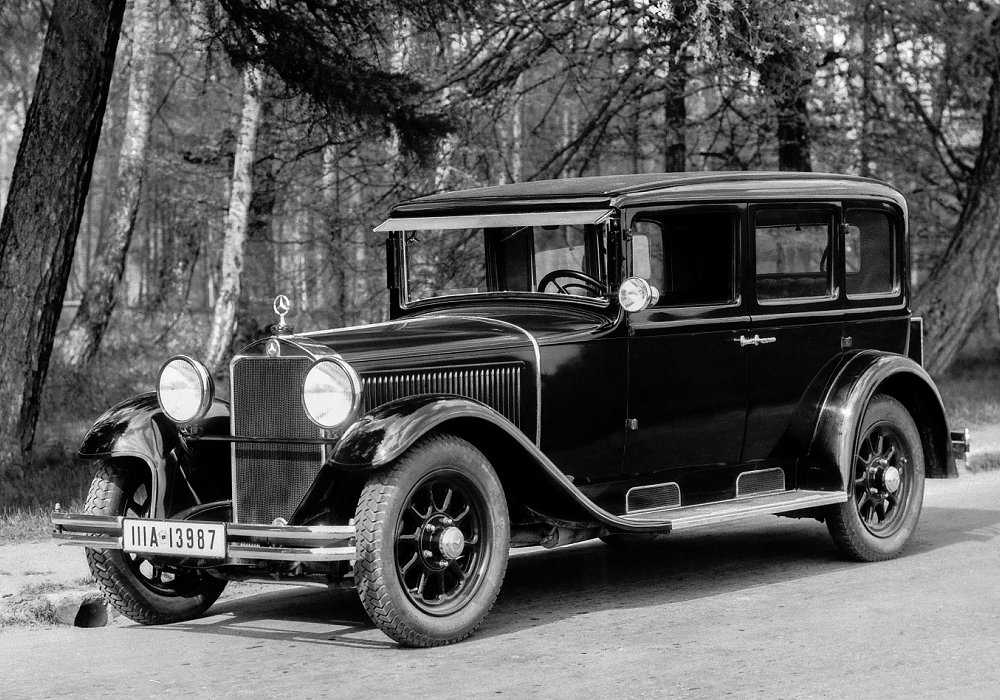
The 350 Mannheim could be ordered with a variety of body types, many of them produced at the Sindelfingen works. These included formal limousines, Pullman-style sedans, cabriolets and open tourers. The styling reflected the transitional nature of late-1920s design, blending upright radiators and tall rooflines with increasingly streamlined forms. Bodies were characterised by long bonnets, sweeping wings and well-proportioned passenger compartments. Cabriolet versions offered open-air luxury, while closed-body variants provided dignity and presence suitable for business use or chauffeur-driven service. Regardless of configuration, build quality was consistently high, with solid construction, carefully fitted panels and fine detailing.
Inside, the 350 Mannheim was appointed with the comfort expected of an upper-middle-class Mercedes-Benz model. Interiors typically featured deep, comfortable seats upholstered in quality cloth or leather depending on specification. The dashboard carried simple but attractive instrumentation, with clear gauges for speed, fuel, oil pressure and temperature. Wood trim, polished metal fittings and robust door hardware reinforced the sense of quality and durability. Although not lavish in the manner of the company’s flagship models, the cabin conveyed solidity and refinement and was well suited to long-distance touring or formal travel.
On the road, the car delivered the measured, secure performance characteristic of pre-war Mercedes-Benz engineering. The six-cylinder engine provided quiet, steady torque, and the gearbox allowed smooth progress at a relaxed pace. The suspension absorbed rough surfaces effectively, making the car comfortable for long journeys even when road conditions were poor. The heavy construction gave the car a reassuringly planted feel, though it required deliberate steering input and thoughtful gear selection. Owners appreciated its reliability, mechanical strength and dignified character, all of which contributed to its success among professional and private buyers alike.
The 350 Mannheim sat in an important position within the Mercedes-Benz hierarchy. It offered more power and refinement than the Stuttgart models but avoided the cost and scale of the high-end Nürburg series. As such, it appealed to senior professionals, entrepreneurs and institutions that wanted a substantial, prestigious car without entering the realm of chauffeur-only luxury. Production continued until 1930, when evolving customer expectations and increasing competition pushed Mercedes-Benz toward more modern designs.
Today, the Mercedes-Benz 350 Mannheim is regarded as a significant transitional model in the company’s pre-war history. It demonstrates the refinement of Mercedes-Benz engineering during the late 1920s and showcases the early development of the company’s hallmark six-cylinder character. Surviving examples highlight the craftsmanship, durability and understated elegance that made the 350 Mannheim a respected and successful model in its time.