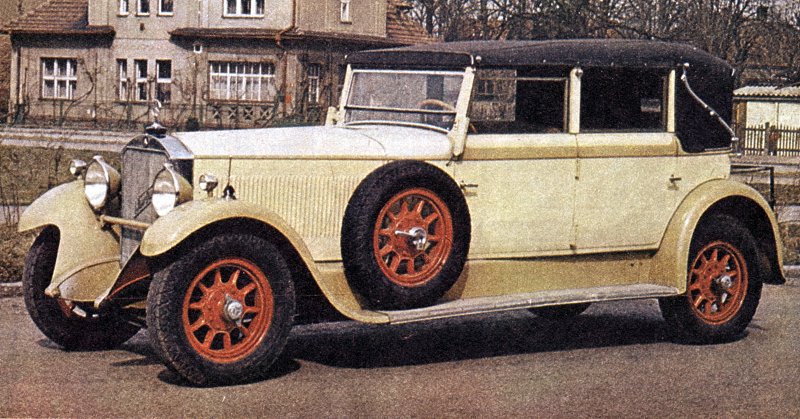
Description
The Mercedes-Benz 460 Nürburg Cabriolet was one of the most distinguished and luxurious open-body variants of the early Nürburg series, a model introduced in 1928 as Mercedes’ first production car designed specifically around an eight-cylinder engine. Named after the famous Nürburg Fortress near the Nürburgring, the 460 represented Mercedes’ attempt to enter the upper-luxury segment dominated by large American straight-eights and the grand European tourers of the late 1920s. In Cabriolet form, it combined the imposing stature of a full-size prestige car with the relaxed elegance of open-top motoring.
At the heart of the 460 Nürburg was its 4.6-litre inline-eight, a smooth and flexible engine producing around 80–90 horsepower depending on specification and year. Although not designed for sporting performance, it delivered excellent torque, quiet operation and refined cruising ability. The eight-cylinder layout gave the car a level of mechanical smoothness that set it apart from six-cylinder competitors in the luxury class. Paired with a four-speed manual gearbox, the engine provided steady and dignified progress, allowing the large car to reach speeds of around 100–110 km/h—impressive for such a substantial machine.
The Nürburg chassis was a robust ladder-frame design engineered to accommodate the long bonnet and the weight of the straight-eight powerplant. Early versions used solid axles with semi-elliptic leaf springs, while later refinements improved rigidity and comfort without losing durability. Four-wheel mechanical drum brakes gave the car reliable stopping power. Steering effort was significant at very low speeds, as was common for heavy luxury cars of the era, but once underway the Nürburg felt stable and predictable. Mercedes engineered it as a long-distance touring car, capable of crossing countries with minimal fatigue for both driver and passengers.
The Cabriolet body was one of the most elegant configurations offered on the 460 chassis. Built either by Mercedes’ Sindelfingen works or by leading custom coachbuilders, these bodies typically featured a two- or four-door layout with a fully folding fabric roof. The proportions were majestic: a tall, upright radiator; a long bonnet; sweeping front wings; a spacious passenger cabin; and an elegant tail that housed the roof when folded. Many examples featured a dual-cowl arrangement or finely crafted window frames, underscoring the craftsmanship and prestige associated with the model. The Cabriolet design allowed occupants to enjoy open motoring in good weather while offering proper protection when the top was raised.
Inside, the Nürburg Cabriolet embodied traditional Mercedes luxury with broad, comfortable seating, high-quality upholstery and polished wood detailing. The dashboard carried neatly arranged instruments, including speedometer, oil pressure, fuel and ammeter—presented with precision and clarity. The seating position was upright and commanding, appropriate for a car intended as both a chauffeur-driven limousine and a privately owned touring cabriolet. Attention to fit, finish and cabin acoustics gave the car an atmosphere of calm refinement quite ahead of its time.
Driving the 460 Nürburg Cabriolet was an experience shaped by smoothness and authority rather than speed. The eight-cylinder engine delivered power gently and without fuss, and the car’s weight and long wheelbase gave it a steady, unflustered motion even on less than perfect roads. Its open body added a sense of occasion, making it ideal for relaxed summer travel, grand sightseeing journeys or formal occasions where elegance mattered as much as engineering.
The Nürburg played an important role in Mercedes’ lineup at a time when the company was establishing its identity in the luxury market. It was their first serious attempt to challenge American luxury cars on equal terms, showing that Mercedes could build large, sophisticated eight-cylinder automobiles with the same engineering integrity as their smaller, more sporting models. Although overshadowed today by the dramatic supercharged S-Series, the Nürburg was a key pillar of Mercedes’ prestige offerings during the late 1920s and early 1930s.
Today, the Mercedes-Benz 460 Nürburg Cabriolet is appreciated by collectors for its imposing presence, refined engineering and elegant handcrafted bodies. Surviving examples are rare, and those in good condition stand as striking reminders of an era when craftsmanship, comfort and mechanical poise defined the top tier of luxury motoring. It remains one of the most dignified and sophisticated open Mercedes models of the early pre-war period.