Description
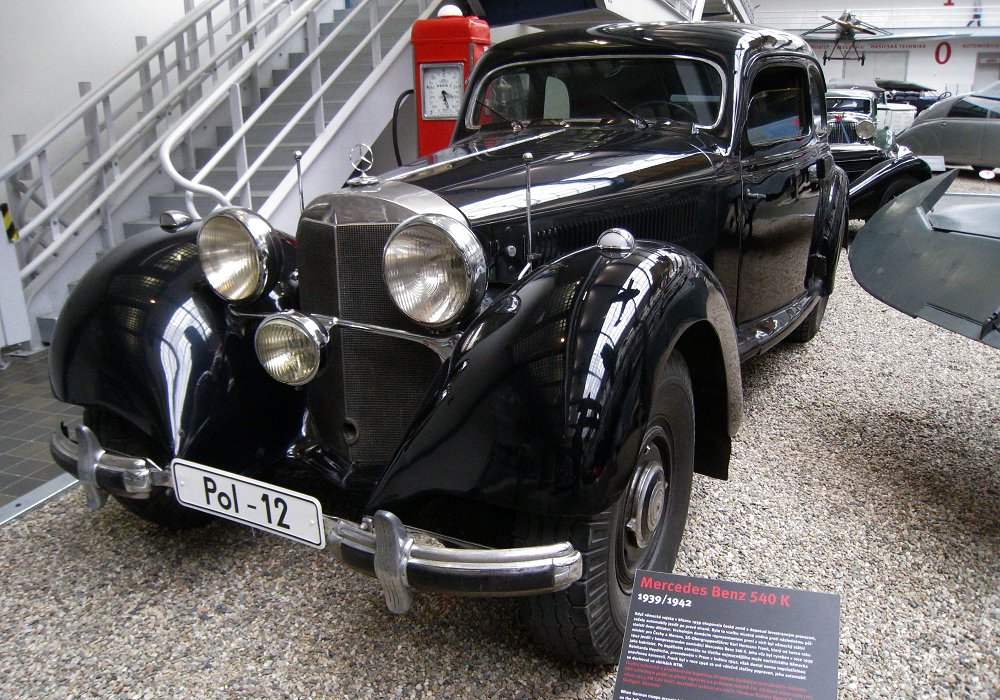
The Mercedes-Benz 540 KP was a specialised and relatively little-known variant within the 540 K family, developed to meet demanding operational requirements rather than private luxury motoring. The “P” designation referred to Polizeiwagen, indicating its intended role as a high-performance police and state service vehicle. Built in the late 1930s, the 540 KP combined the formidable supercharged engineering of the 540 K with a more functional body and equipment tailored for official use, making it one of the most powerful and capable service vehicles of its era.
Power was provided by the same 5.4-litre inline-eight engine used throughout the 540 K range, fitted with a Roots-type supercharger. In standard operation the engine ran without boost, delivering smooth and controlled performance suitable for routine driving. When the accelerator was fully depressed, the supercharger engaged automatically, raising output to approximately 180 horsepower and providing immense torque. This gave the 540 KP extraordinary acceleration and top-speed capability for a service vehicle, allowing it to escort, pursue or rapidly deploy personnel as required. A four-speed manual gearbox transmitted power to the rear wheels, and the engine’s flexibility allowed effective performance across a wide range of driving conditions.
The 540 KP was built on the low-frame chassis of the 540 K, which positioned the body deep between the axles and lowered the centre of gravity. This design provided improved stability at speed, an important attribute for a vehicle expected to operate rapidly and confidently on public roads. Suspension consisted of semi-elliptic leaf springs at both front and rear, tuned to support durability and load-carrying capability while maintaining reasonable ride comfort. Hydraulic brakes on all four wheels delivered strong and reliable stopping power, essential given the car’s performance potential and operational role.
Bodywork on the 540 KP differed from the more luxurious cabriolet and limousine versions. It was typically more restrained and functional, prioritising practicality, visibility and robustness over ornamentation. Bodies were often closed saloons or simplified open configurations, depending on operational needs. Chrome trim was minimal, and interior appointments were more utilitarian than those of private 540 K models. The emphasis was on reliability, space for equipment and personnel, and the ability to operate effectively in all conditions rather than comfort or visual drama.
Inside, the 540 KP featured a functional interior designed for professional use. Seating was durable and supportive, often upholstered in hard-wearing materials rather than fine leather. Instrumentation was clear and easy to read, allowing the driver to monitor the powerful engine during demanding operation. Controls were arranged for practicality and ease of use, reflecting the vehicle’s role as a working machine rather than a luxury automobile. Despite its utilitarian focus, the underlying quality of construction remained high, consistent with Mercedes-Benz engineering standards of the period.
On the road, the Mercedes-Benz 540 KP delivered performance that was unmatched by most contemporary service vehicles. The supercharged engine gave it exceptional speed and acceleration, while the low-frame chassis provided stability and confidence at higher speeds. Although heavier and less refined than the private cabriolets, the KP was capable of sustained fast running and rapid response, qualities that made it highly effective in its intended role. Its size and power required skilled handling, but in trained hands it was an extraordinarily capable machine.
Production of the 540 KP was extremely limited, as it was built only for specific official and state requirements. Very few examples were produced, and even fewer are believed to survive today. Its obscurity, combined with its unique purpose, makes it one of the rarest and most intriguing variants of the 540 K family.
Today, the Mercedes-Benz 540 KP is regarded as a fascinating footnote in Mercedes-Benz history. It stands as an example of how the company adapted its most advanced luxury engineering to serve official and operational roles, creating a vehicle of extraordinary performance and authority. Surviving examples, if any, are of immense historical interest, offering insight into a seldom-seen aspect of pre-war Mercedes-Benz production and the broader use of high-performance automobiles in state service during the 1930s.