Description
The Mercedes-Benz 580 K Sport Roadster was one of the most ambitious and mysterious projects of Mercedes-Benz’s pre-war supercharged era, representing a planned evolution beyond the already formidable 540 K. Conceived in the late 1930s, the 580 K was intended to push performance, displacement and prestige even further, placing it at the absolute summit of Mercedes-Benz’s luxury and sporting ambitions before the outbreak of the Second World War. Although it never entered full production, the 580 K Sport Roadster has become a legendary “what might have been” in automotive history.
The heart of the 580 K concept was an enlarged supercharged inline-eight engine, believed to have displaced approximately 5.8 litres. Like the 500 K and 540 K, it was designed to operate in two modes, running naturally aspirated under normal driving and engaging a Roots-type supercharger under full throttle. Output was projected to exceed that of the 540 K, with estimates typically placing it well above 180 horsepower. The emphasis was not merely on peak speed, but on overwhelming torque and effortless high-speed cruising, reinforcing Mercedes-Benz’s philosophy of supercharged luxury rather than outright racing performance. Power would have been transmitted through a four-speed manual gearbox, exploiting the engine’s immense flexibility.
The 580 K Sport Roadster was intended to use an advanced low-frame chassis, further refined from the 540 K platform. By mounting the body deep between the axles, Mercedes-Benz engineers aimed to maintain stability and composure despite the increased power and weight. Suspension would have followed established practice with semi-elliptic leaf springs front and rear, carefully tuned for high-speed stability rather than comfort alone. Hydraulic brakes on all four wheels were a necessity given the projected performance, and the overall chassis design suggested a car capable of sustained fast touring at a level unmatched by contemporaries.
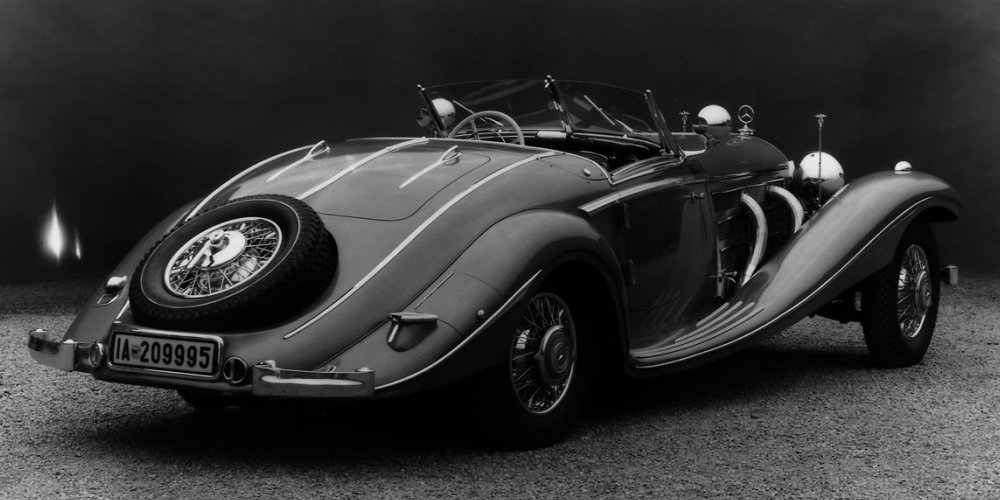
The Sport Roadster body was envisioned as the most aggressive and athletic expression of Mercedes-Benz design. Following the philosophy of the Spezial Roadsters, it would have featured an exceptionally long bonnet, deeply sculpted wings, a low and rearward-set cockpit and a sharply raked windscreen. The proportions were intended to communicate speed and power even at rest, with minimal concessions to comfort or practicality. The folding roof was likely to have been rudimentary, included more as a formality than as a true weather solution, reinforcing the car’s sporting focus.
Inside, the 580 K Sport Roadster would have prioritised the driver and passenger above all else. Seating was expected to be low and supportive, trimmed in fine leather, with a cockpit layout focused on control and mechanical awareness rather than luxury excess. Instrumentation would have followed Mercedes-Benz practice with clear, functional gauges monitoring engine speed, boost and vital systems. While still impeccably crafted, the interior would have been more purposeful than that of the cabriolets or limousines, reflecting the car’s intent as a high-performance grand tourer.
On the road, had it reached production, the 580 K Sport Roadster would almost certainly have been one of the fastest and most commanding road cars in the world. The combination of a larger supercharged engine, low-frame chassis and aggressive bodywork suggested performance well beyond that of the 540 K. It was conceived as a car for open roads, where its immense torque, stability and presence could be fully exploited by skilled drivers. Like other supercharged Mercedes models, it would have demanded respect and restraint, rewarding smooth, confident driving rather than aggression.
The 580 K project was ultimately overtaken by events. The outbreak of the Second World War halted development, and Mercedes-Benz’s focus shifted entirely to military production. As a result, the 580 K Sport Roadster never progressed beyond prototype or planning stages, and no confirmed production examples are known to exist. Its legend has been sustained through factory records, period references and later reconstructions that attempt to imagine what the finished car might have been.
Today, the Mercedes-Benz 580 K Sport Roadster occupies a unique place in pre-war automotive history. It represents the absolute peak of Mercedes-Benz’s supercharged luxury philosophy and the final, unrealised step in the evolution that began with the 380 Kompressor and culminated in the 540 K. As a concept, it stands as a symbol of engineering ambition interrupted by history, and as a legend, it remains one of the most fascinating and elusive “lost” supercars of the pre-war era.