Description
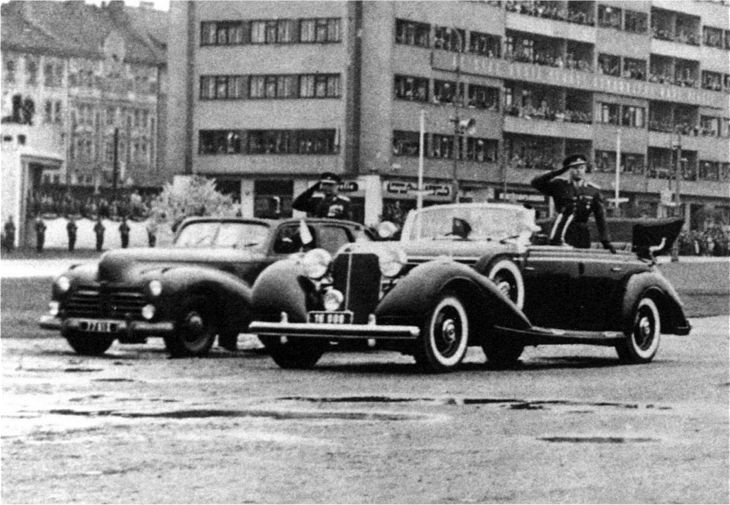
The Mercedes-Benz 770 K was the supercharged evolution of Mercedes-Benz’s flagship luxury automobile, developed to provide even greater power, authority and operational capability than the standard 770. Introduced during the early 1930s as part of the W07 generation, the 770 K combined the immense scale and refinement of the original model with Kompressor technology, reinforcing Mercedes-Benz’s position as the world leader in high-performance prestige automobiles. The “K” designation, standing for Kompressor, signified the use of forced induction and placed the car among the most powerful road-going vehicles of its era.
At the heart of the 770 K was the enormous 7.7-litre inline-eight engine fitted with a mechanically driven Roots-type supercharger. In normal driving conditions the engine operated without boost, delivering exceptionally smooth and quiet progress despite the vehicle’s immense mass. When the accelerator was fully depressed, the supercharger engaged, raising output to approximately 150 horsepower and unleashing vast reserves of torque. This allowed the 770 K to accelerate with surprising authority and maintain high cruising speeds with ease, even when fully laden. Power was delivered through a four-speed manual gearbox designed to cope with the engine’s immense torque output, allowing controlled and deliberate progress suited to the car’s role.
The chassis of the 770 K was a massive ladder-frame construction engineered specifically for strength, durability and stability. The long wheelbase provided exceptional straight-line composure and ample space for large, formal body styles. Suspension consisted of heavy-duty semi-elliptic leaf springs at both front and rear, prioritising load-bearing capacity and ride smoothness over agility. Braking systems evolved during production, with mechanical brakes on early examples and improvements introduced as the model developed. The overall driving character was stately and commanding, emphasising control and reliability rather than responsiveness.
The 770 K was available with a variety of body styles, most commonly formal limousines, Pullman limousines and open touring configurations. These bodies were produced primarily by the Sindelfingen coachworks and were designed to project authority, dignity and prestige. Styling was upright and imposing, with a towering radiator grille, long bonnet and expansive passenger compartment. Ornamentation was restrained, reflecting the car’s official and ceremonial role rather than private luxury flamboyance. Many examples were configured specifically for state use, with fittings and layouts tailored to official requirements.
Inside, the Mercedes-Benz 770 K offered an interior that balanced luxury with functional robustness. Seating was generous and upright, typically upholstered in fine leather or durable cloth. The rear compartment was designed to provide maximum comfort and visibility for senior passengers, while the chauffeur’s area was more utilitarian but still finished to high standards. Instrumentation was clear and functional, allowing the driver to monitor the powerful engine under demanding conditions. Craftsmanship throughout the cabin reflected Mercedes-Benz’s emphasis on durability, precision and long-term serviceability.
On the road, the 770 K delivered an experience defined by effortless power and absolute presence. The supercharged engine allowed the car to move without strain regardless of load or terrain, and the long chassis smoothed out road imperfections with a calm, authoritative ride. While the vehicle demanded skill and anticipation from the driver due to its size and braking characteristics, it rewarded smooth inputs with unmatched stability and composure. The engagement of the supercharger provided a reserve of performance that few, if any, contemporaries could rival.
The Mercedes-Benz 770 K became closely associated with government and state use, particularly in Germany during the 1930s. Its imposing appearance and mechanical dominance made it a highly visible symbol of political power and authority. This association has given the model a complex historical legacy, combining extraordinary engineering achievement with the political context in which it was employed.
Production numbers of the 770 K were extremely limited, reflecting its specialised purpose, high cost and bespoke nature. Many examples were later superseded by the more advanced W150 series, but the 770 K remains an important step in the evolution of Mercedes-Benz’s supercharged flagships.
Today, the Mercedes-Benz 770 K is regarded as one of the most formidable automobiles of the pre-war period. It stands as a testament to Mercedes-Benz’s ability to engineer vehicles of unprecedented scale and power, and as a historical artifact it offers insight into an era when the automobile was used not only as transportation, but also as an instrument of state presence and authority.