Description
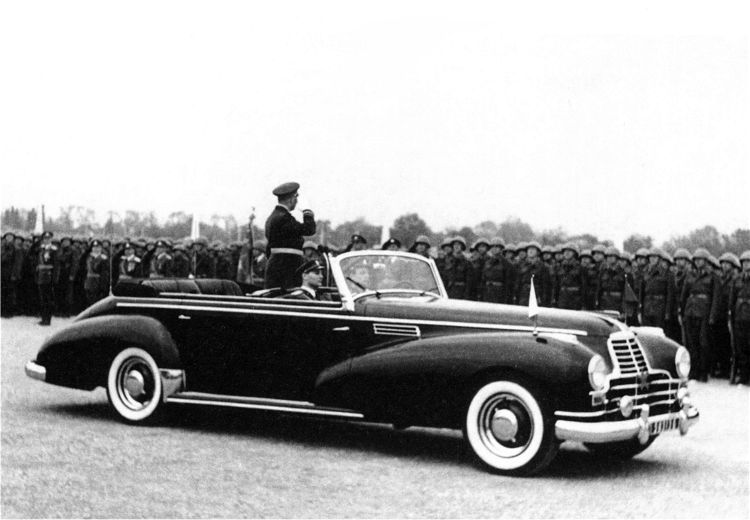
The Mercedes-Benz 770 Karosa was a rare and distinctive coachbuilt interpretation of Mercedes-Benz’s flagship supercharged limousine, combining German mechanical dominance with the craftsmanship of the Czech coachbuilder Karosa of Vysoké Mýto. Built on the formidable 770 chassis during the 1930s, this variant stood apart from the more familiar Sindelfingen-bodied cars, reflecting regional coachbuilding traditions while retaining the immense authority, power and prestige that defined the Mercedes-Benz 770. It represented the international reach of Mercedes-Benz luxury and the willingness of elite clients to commission bespoke bodies beyond Germany’s borders.
Mechanically, the 770 Karosa shared the same foundations as other 770 models of its generation, most commonly the W07 series. Power was supplied by the colossal 7.7-litre inline-eight engine equipped with a Roots-type supercharger. In normal operation the engine ran without boost, delivering exceptionally smooth and quiet progress despite the vehicle’s size. When full throttle was applied, the supercharger engaged, raising output to approximately 150 horsepower and providing immense torque. This allowed the Karosa-bodied 770 to move with effortless authority, whether used for formal transport, diplomatic duties or long-distance touring. A four-speed manual gearbox transmitted power smoothly, designed to withstand the engine’s enormous torque output.
The chassis was a massive ladder-frame construction engineered for stability, durability and load-bearing capacity. The long wheelbase provided generous interior space and exceptional straight-line composure, qualities essential for a formal flagship automobile. Suspension used heavy-duty semi-elliptic leaf springs at both front and rear, prioritising comfort and reliability over agility. Braking systems were robust for the era, evolving during production as Mercedes-Benz refined its flagship models. The overall driving character was stately and deliberate, reinforcing the car’s role as a vehicle of authority rather than a sporting machine.
What distinguished this version was the Karosa coachwork. Known primarily for high-quality buses and commercial bodies, Karosa also produced bespoke automobile bodies to special order, particularly for Central and Eastern European clients. Their interpretation of the 770 emphasised solidity, dignity and practicality, often with cleaner, more restrained lines than some of the more imposing German factory bodies. The proportions remained commanding, with a long bonnet, upright radiator and expansive passenger compartment, but details such as window shapes, roofline treatment and rear body contours reflected Karosa’s own design language. The result was a formal limousine that projected authority without excessive ornamentation.
Inside, the Mercedes-Benz 770 Karosa offered a spacious and well-appointed interior tailored to its intended role. Upholstery was typically finished in high-quality leather or durable cloth, depending on customer preference. The rear compartment was designed for comfort and visibility, with generous legroom and upright seating suitable for formal use. Wood trim, polished metal fittings and solid hardware reflected the emphasis on durability and craftsmanship. The chauffeur’s compartment was more functional, featuring clear instrumentation and controls designed for professional operation rather than luxury excess.
On the road, the 770 Karosa delivered the same commanding experience as other 770 variants. The enormous engine provided smooth, effortless acceleration, while the long wheelbase and heavy construction produced a calm, authoritative ride. The supercharger ensured that even steep gradients or heavy loads could be managed without strain. While the car required careful handling due to its size and braking limitations, it rewarded smooth, deliberate driving with unmatched stability and presence.
Production of Karosa-bodied Mercedes-Benz 770s was extremely limited, likely confined to a handful of special commissions. Their rarity today is compounded by the already low production numbers of the 770 series itself. As a result, surviving examples are exceptionally scarce and of great historical interest.
Today, the Mercedes-Benz 770 Karosa is regarded as a fascinating example of international pre-war coachbuilding applied to one of the most formidable automotive platforms ever produced. It illustrates how Mercedes-Benz’s flagship engineering was adapted to regional tastes and requirements, resulting in a unique blend of German mechanical supremacy and Central European craftsmanship. As a historical artifact, it stands as a rare and intriguing variation within the storied legacy of the Mercedes-Benz 770.