Description
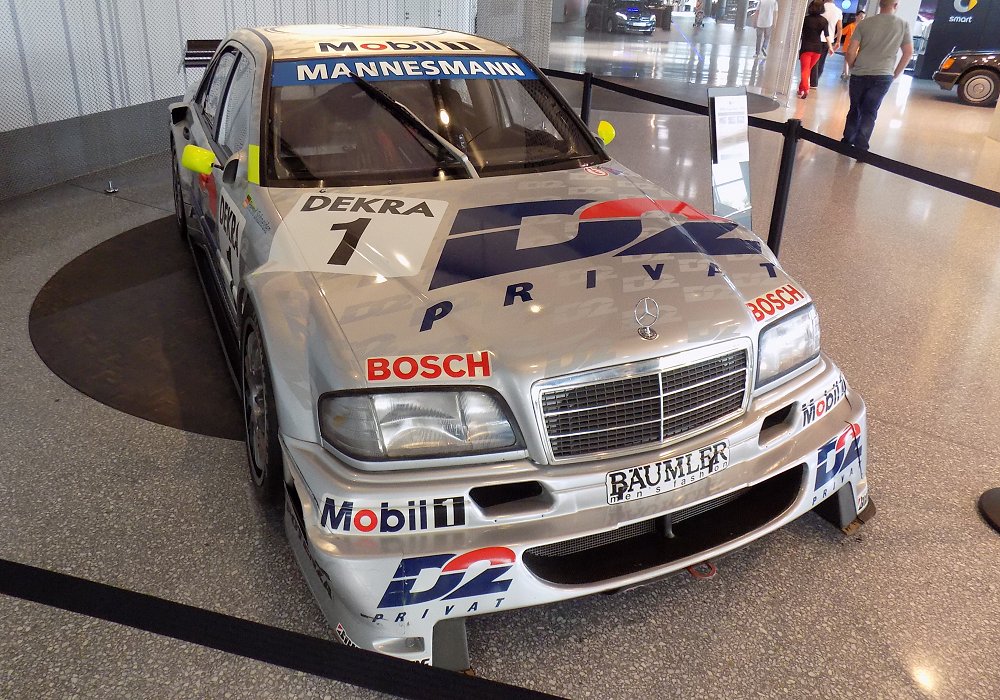
The Mercedes-Benz C W202 DTM was a purpose-built touring car developed by Mercedes-Benz for competition in the Deutsche Tourenwagen Meisterschaft during the mid-1990s. Although it shared its name and basic silhouette with the road-going C-Class W202, the DTM car was a highly specialised racing machine, engineered to compete at the very highest level of German touring car competition. It played a central role in Mercedes-Benz’s return to top-tier motorsport and became one of the most successful and recognisable DTM cars of its era.
The W202 DTM car was developed under the Class 1 regulations that governed DTM during the 1990s. These rules allowed extensive technical freedom beneath a body shell that only loosely resembled the production car. While the road-going C-Class was available with four- and six-cylinder engines driving the rear wheels, the DTM version featured a bespoke naturally aspirated V6 engine mounted longitudinally. Displacement was 2.5 litres, in line with the regulations, and power output was in the region of 400 horsepower, achieved through extremely high engine speeds and advanced racing technology.
Power was transmitted through a sequential racing gearbox, and unlike the production C-Class, the DTM car used permanent four-wheel drive. This system was developed to maximise traction and cornering stability, giving the Mercedes a significant advantage under acceleration and in variable grip conditions. The drivetrain, gearbox and differential systems were all racing-specific and bore no relation to road car components.
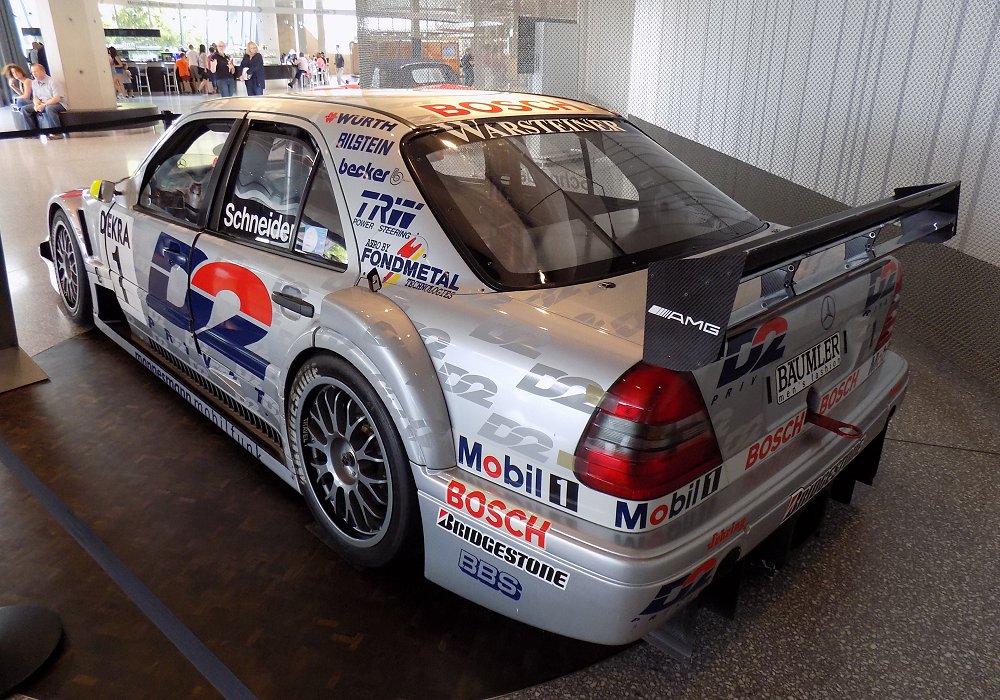
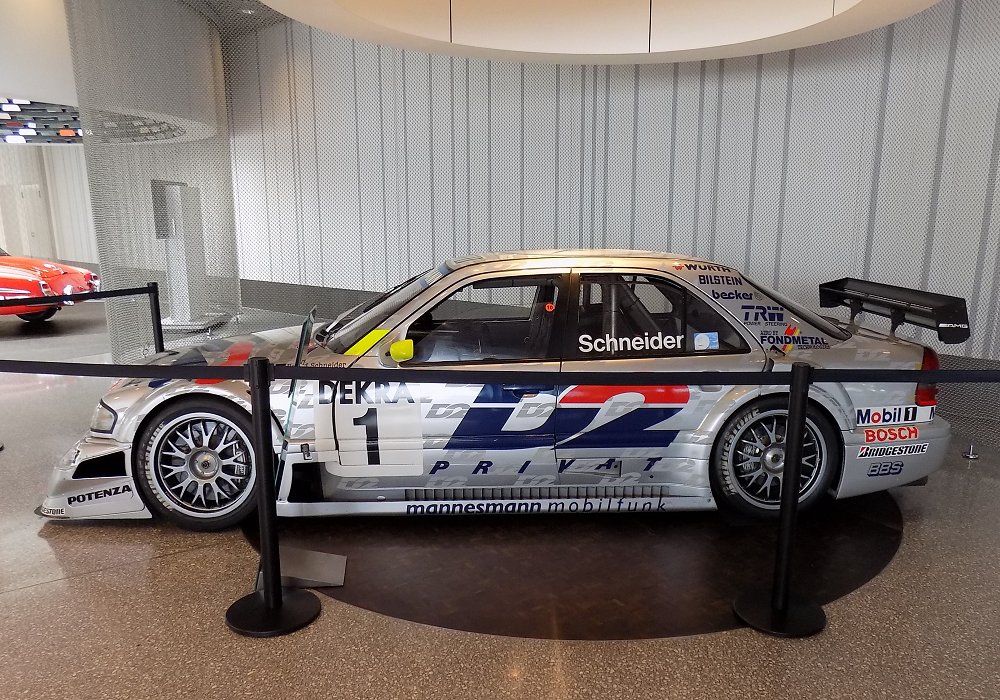
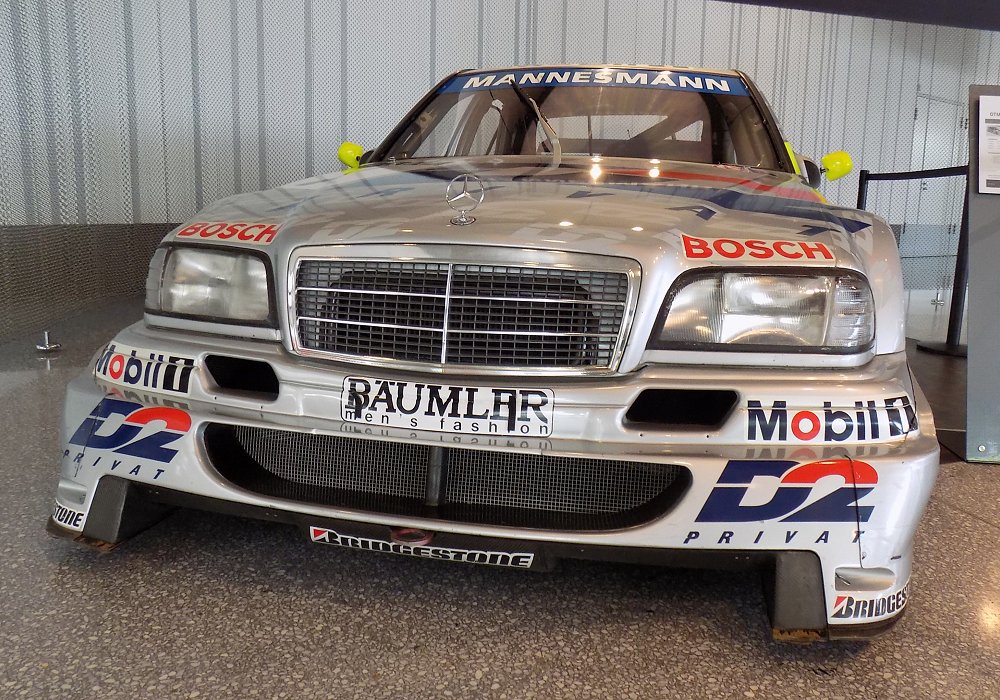
The chassis of the Mercedes-Benz C W202 DTM was a carbon-fibre monocoque, another major departure from the steel-bodied production car. Suspension was fully independent with racing geometry, pushrod-actuated dampers and extensive adjustability. Aerodynamics played a critical role, with a wide body, aggressive front splitter, complex underfloor and a large rear wing designed to generate substantial downforce. Although the car retained the general outline of the W202 C-Class, every panel was optimised for airflow and cooling rather than road use.
Visually, the C W202 DTM became an icon of 1990s touring car racing. The exaggerated wheel arches, low stance and prominent aerodynamic elements gave it a dramatic and purposeful appearance. Works liveries, particularly those featuring silver and sponsor branding, reinforced Mercedes-Benz’s motorsport identity and echoed the company’s historic “Silver Arrows” heritage in a modern touring car context.
Inside, the cockpit was stripped entirely for racing. A single racing seat, full roll cage, digital displays and minimal controls replaced any notion of road car comfort. Driver safety was paramount, with advanced crash structures and fire suppression systems integrated into the car’s design. Everything inside the cabin was focused on performance, reliability and driver control.
On track, the Mercedes-Benz C W202 DTM proved to be highly competitive. It achieved major success during the 1994 and 1995 seasons, including championship victories and multiple race wins. The car was driven by some of the most talented touring car drivers of the era and became a benchmark for performance under the Class 1 rules. Its success also highlighted the escalating costs and technical complexity of DTM, which ultimately contributed to the series’ temporary collapse in the mid-1990s.
The C W202 DTM competed directly against similarly advanced rivals from Alfa Romeo and Opel, creating one of the most technologically sophisticated and fiercely contested periods in touring car history. Races were characterised by high speeds, aggressive driving and close competition, with the Mercedes frequently at the front of the field.
Today, the Mercedes-Benz C W202 DTM is regarded as one of the most important touring cars ever built. It represents a peak moment in DTM history, when technical innovation and manufacturer involvement reached unprecedented levels. Surviving examples are extremely rare and are typically found in manufacturer collections or museums, where they are valued as significant motorsport artefacts.
As a racing machine, the Mercedes-Benz C W202 DTM has little in common mechanically with the road-going C-Class, but its impact on Mercedes-Benz’s performance image was profound. It reinforced the brand’s motorsport credentials, laid foundations for future AMG racing programmes, and remains a symbol of an era when touring car racing rivalled Formula One in technical ambition and spectacle within the Deutsche Tourenwagen Meisterschaft.