Description
The Mercedes-Benz S was the first model in the legendary S-Series (“Sportwagen”) that defined Mercedes’ reputation for supercharged high-performance automobiles in the late 1920s. Introduced in 1927 as the successor to the 630 K, the S represented a major leap forward in power, handling and competition capability. It set the foundation for the even more dramatic SS and SSK models that followed, but even in its own right the S was one of the fastest and most imposing sports cars of its era.
The S was powered by a 6.8-litre inline-six fitted with Mercedes’ mechanical Roots-type supercharger. In normal running the engine produced around 120 horsepower, but when the Kompressor engaged—activated through full throttle—the output jumped to approximately 180 horsepower. For the mid-1920s, this was extraordinary power, giving the S explosive acceleration and a deep, forceful engine note that became one of the hallmarks of Mercedes’ supercharged models. The Kompressor delivered immediate torque, making the car exceptionally strong on hills and rapid out of low-speed corners, an advantage in competition.
The chassis was derived from the earlier 630 K but significantly re-engineered. It retained the rigid ladder-frame layout but featured a lower centre of gravity, a strengthened structure and revised mounting points for the engine and suspension. The S sat on a shorter wheelbase and a lowered frame, improving agility despite its size. Suspension used semi-elliptic leaf springs front and rear, tuned for sporting use rather than pure comfort. Four-wheel mechanical drum brakes provided strong stopping capability for the period and were essential given the car’s performance.
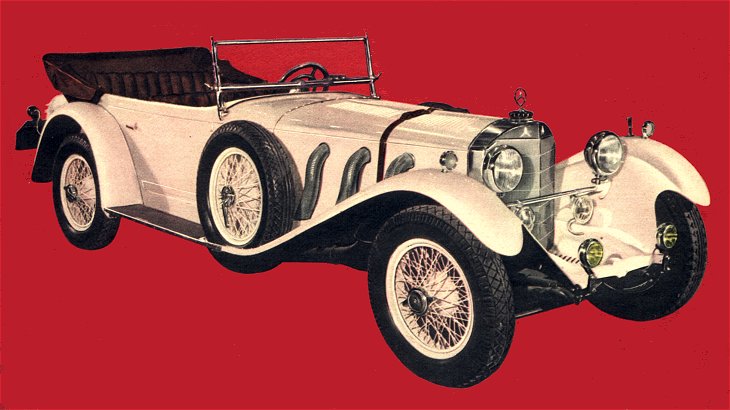
The bodywork of the Mercedes S varied depending on coachbuilder and intended use, but the most iconic form was the open two- or four-seat sports tourer. These bodies emphasised performance: a long bonnet, upright radiator, flowing wings, exposed side-exit exhaust and a slightly rear-set cockpit. The look was purposeful and aggressive, reflecting the car’s competition role. Lightweight construction was prioritised for racing variants, while customer tourers could be fitted with more luxurious trim and features.
Inside, the S combined simplicity with craftsmanship. Sports versions featured a sparse, functional cockpit with leather bucket seats, a clearly arranged instrument panel and exposed mechanical linkages. More luxurious examples included finer upholstery and additional fittings, but every version of the S maintained a driver-focused layout. The steering wheel was large, the gear lever long and mechanical, and the view over the immense bonnet gave a commanding sense of presence.
On the road, the Mercedes S was one of the most formidable performance cars available in the late 1920s. With the supercharger engaged, it delivered thrilling acceleration and high cruising speeds that few rivals could match. The lowered chassis improved cornering stability, and although the suspension remained firm by touring standards, the car handled with surprising confidence for its size. Its strong brakes and robust construction made it well suited to demanding long-distance events.
The S quickly became a major force in motorsport. It excelled in hillclimbs, endurance events and road races, particularly in Germany, Italy and Austria. Its combination of power, durability and traction made it a favourite among privateer racers. Success in competition directly influenced the evolution of the model into the even more powerful SS and the short-wheelbase SSK, both of which became icons of pre-war motorsport.
Today, the Mercedes-Benz S is regarded as one of the most important early supercharged models produced by the marque. It marks the transition from Mercedes’ luxury touring roots into the full-blooded sports cars that would dominate European racing. Surviving examples are rare and extremely valuable, admired for their engineering significance, imposing presence and role as the foundation of the legendary S-Series. The Mercedes S remains a masterpiece of the late 1920s—a blend of brute force, mechanical purity and elegant sporting design.