Description
The Mercedes-Benz S Erdmann & Rossi was one of the most exclusive and visually striking interpretations of the early Mercedes S-Series, combining the raw performance of the 1927 Mercedes S with the dramatic, hand-crafted luxury of Berlin’s celebrated coachbuilder Erdmann & Rossi. Created for a small and wealthy clientele, it elevated an already formidable sporting machine into a bespoke masterpiece, blending engineering power with artisanal elegance.
Underneath the custom coachwork lay the formidable mechanical heart of the Mercedes S. Its 6.8-litre inline-six engine featured a mechanically driven Roots-type supercharger, producing around 120 horsepower naturally aspirated and up to approximately 180 horsepower when the Kompressor engaged under full throttle. This sudden increase in power delivered strong acceleration and a distinctive supercharger growl, making the Mercedes S one of the fastest and most imposing sporting cars of the late 1920s. Even with elaborate coachbuilt bodywork, the car retained the power and urgency that defined the S-Series.
The chassis was Mercedes’ strengthened short-wheelbase ladder frame, derived from the 630 K but significantly lowered and reinforced. Designed with sporting performance in mind, it combined agility with impressive durability. Semi-elliptic leaf springs and robust axles kept the ride firm but controlled, while the four-wheel mechanical drum brakes offered stopping power that outclassed many rivals of the day. Even with the added weight of a luxurious body, the Mercedes S retained its confident handling and long-distance touring capability.
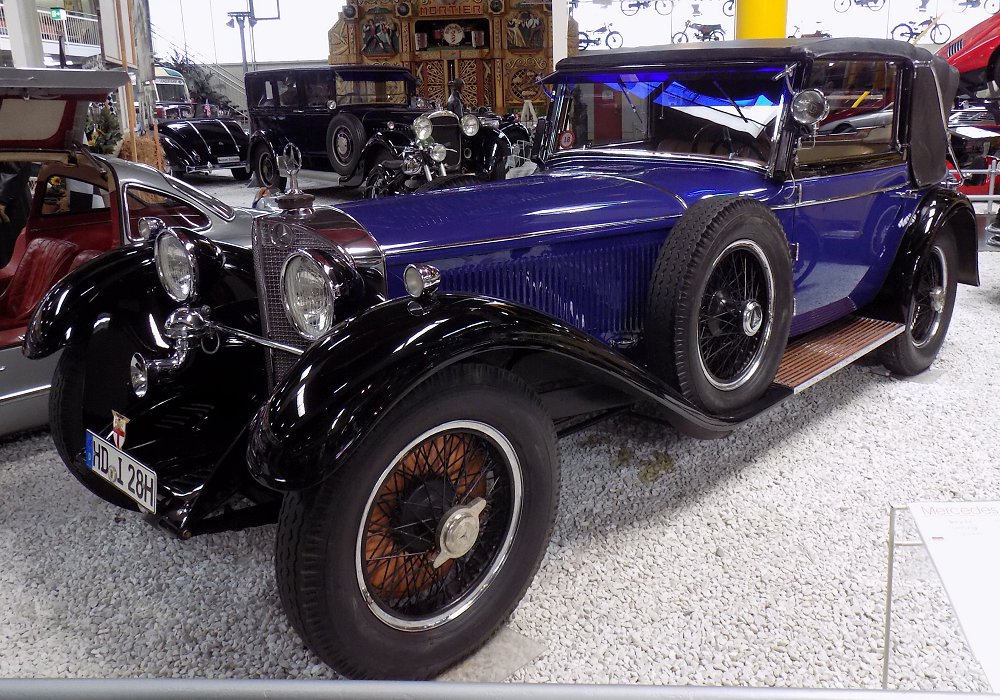
Erdmann & Rossi’s contribution transformed the car’s identity. As one of Germany’s most respected coachbuilders, the firm was known for sculpted proportions, sweeping lines and a meticulous sense of elegance. Their bodies for the Mercedes S were typically open tourers, graceful cabriolets or dramatic dual-cowl phaetons. Long flowing front wings emphasised the length of the chassis, while the rear wings were sculpted into the body in a way that created a cohesive and aerodynamic appearance. Spare wheels mounted on the front fenders reinforced the car’s sporting aura. The soft tops they constructed were carefully tailored and folded cleanly, maintaining the car’s graceful silhouette whether raised or lowered.
The cabins were executed with the same degree of craftsmanship. Erdmann & Rossi interiors used fine leather upholstery, expertly stitched, with beautifully polished wood trim and carefully machined metal fittings. The dashboard blended Mercedes’ precise mechanical instrumentation with the coachbuilder’s refined layout. Seating was deep and comfortable, whether arranged in a two-seat sports layout or a more spacious four-seat grand touring arrangement. Even the hardware of the doors and convertibles was manufactured to a high standard, giving the interior a sense of artisanal quality.
On the road, the Mercedes-Benz S Erdmann & Rossi embodied the dual nature that defined the S-Series. Driven at modest speeds, it behaved as a smooth and imposing grand tourer, perfectly suited to elegant motoring on long boulevards. But when the Kompressor engaged, the character changed dramatically. The sudden surge of power gave the car rapid acceleration, making it feel surprisingly light-footed for a large luxury vehicle. The strong brakes and stiff chassis kept the car stable even at high speeds, allowing it to tackle mountain passes and long-distance routes with confidence.
Historically, the Mercedes S Erdmann & Rossi represents a uniquely important moment in German automotive culture. It captured the intersection between Mercedes’ growing dominance in high-performance engineering and the sophisticated artistry of European bespoke coachbuilding. These cars anticipated the even more spectacular SS and SSK models that would come later and remain among the most distinctive and dramatic pre-war Mercedes automobiles ever created.
Today, surviving examples of this collaboration are extraordinarily rare and deeply coveted. Their combination of mechanical significance, bespoke styling and cultural prestige makes them some of the most desirable coachbuilt Mercedes models of the era. The Mercedes-Benz S Erdmann & Rossi stands as an enduring symbol of the golden age of custom automotive craftsmanship, blending power, grace and exclusivity into a single extraordinary machine.