Description
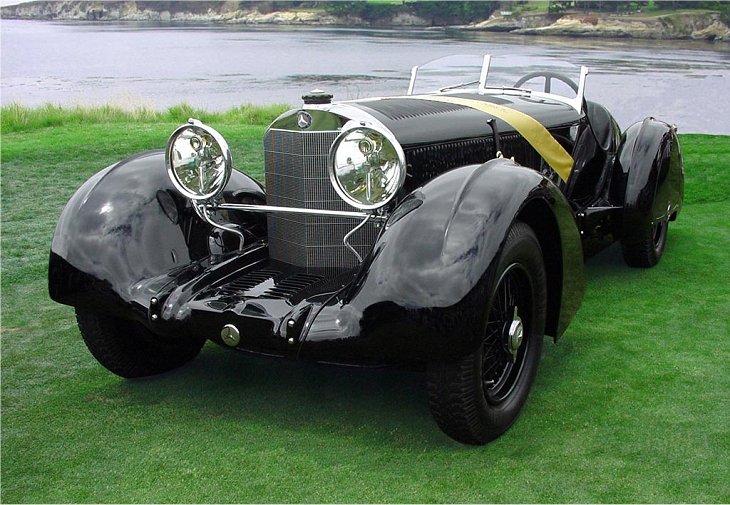
The Mercedes-Benz SSK Trossi was one of the most extraordinary and visually dramatic one-off variants ever created on the legendary SSK chassis. Built in 1932 for Italian aristocrat and racing driver Count Carlo Felice Trossi, this unique machine combined the raw power of Mercedes’ supercharged engineering with highly unconventional, sculptural bodywork. More than any other SSK, the Trossi model became an icon not only of performance but of early automotive design as an art form.
Count Trossi commissioned the body from a specialist Italian team rather than using Mercedes’ usual Sindelfingen or German coachbuilders. The result was a striking, almost fantastical design. The car featured a long, pointed tail tapering into a needle-like rear overhang, exaggerated teardrop wheel fairings and enormous flowing side panels that gave the body an organic, almost living form. The bonnet extended dramatically forward, culminating in an unusually deep, rounded nose. The overall shape looked closer to an Art Deco sculpture or a futuristic prototype than a traditional sports car. The design prioritised dramatic visual impact over practicality, but it created one of the most memorable silhouettes of the entire pre-war era.
Underneath the extraordinary bodywork lay the familiar but formidable Mercedes SSK mechanical foundation. The chassis was the short Kurz version that defined the SSK name, built for responsiveness and competition use. The engine was the enormous 7.1-litre inline-six fitted with Mercedes’ mechanical Roots-type supercharger. In normal running the engine produced powerful torque and roughly 170 horsepower, but when the supercharger engaged under full throttle the output rose to well over 220 horsepower. The Kompressor transformed the car’s pace instantly, making the already dramatic Trossi machine violently fast for its time.
The suspension was the standard SSK setup of semi-elliptic leaf springs front and rear, tuned firmly for high-speed work. The brakes were large mechanical drums on all four wheels, capable for the era but pushed hard by the performance potential of the car. The shortened wheelbase gave it agility but also a lively, demanding handling character. The Trossi body, being heavy and highly sculptural, did not offer the same competition edge as lightweight SSK bodies, but it added stability and a planted feel at high speed.
The cockpit was cramped and purposeful, as in all SSK models. Two leather sport seats sat low in the chassis, positioned far back to balance the long bonnet. The dashboard carried the familiar array of Mercedes mechanical instruments, including the key indicators for oil pressure, coolant temperature, and the tell-tale for Kompressor engagement. The long gear lever and large steering wheel gave the driver commanding control over the heavy but precise mechanical systems. Despite the elaborate exterior, the interior remained focused and functional.
On the road, the Mercedes-Benz SSK Trossi delivered an experience as dramatic as its appearance. With the supercharger disengaged, it behaved like any other SSK: powerful, torquey and surprisingly flexible. With the Kompressor engaged, the car surged forward with immense force, the supercharger’s rising whine echoing from the sculpted bodywork. The aerodynamic advantages of the tapered tail and flowing forms were modest by modern standards, but at the speeds achievable in the early 1930s they contributed to stability. The car could reach very high velocities, although its handling demanded constant vigilance due to the weight and short wheelbase.
The Trossi SSK never had a major competition career, as its elaborate coachwork made it too heavy for top-level hillclimbing or racing. Instead, it existed as a personal high-performance showpiece, a symbol of wealth, taste and engineering bravado. Count Trossi himself was a notable figure in early motor racing, later becoming president of Scuderia Ferrari, and his SSK expressed his flair and passion for extraordinary machinery.
Today, the Mercedes-Benz SSK Trossi is remembered as one of the most remarkable and visually arresting automobiles of the pre-war period. It stands apart from all other SSKs for its sculptural bodywork and its fusion of mechanical might with artistic daring. The car is often referred to as the Trossi Roadster or the Trossi SSK, and although it was not a racing success, its design and aura have made it one of the most famous one-off specials of the early automotive age. It remains a dazzling example of what happens when engineering excellence meets individual creative vision.