

Description
The Mercedes-Benz T80 Rekordwagen was one of the most ambitious and extreme speed-record vehicles ever conceived, representing the absolute pinnacle of pre-war engineering ambition. Developed between 1937 and 1939, the T80 was designed not for circuit racing or road use, but for a single purpose: to claim the outright world land speed record and push automotive performance beyond anything previously attempted. Although it never completed an official record run, the T80 remains one of the most powerful and technically audacious cars ever built.
The project was initiated under the direction of Mercedes-Benz with the explicit goal of surpassing existing land speed records held on salt flats and closed roads. Unlike earlier record cars derived from Grand Prix machines, the T80 was conceived from the outset as a dedicated land-speed vehicle. Its design brought together automotive engineering, aviation technology and advanced aerodynamic research in a way that was unprecedented for a wheeled vehicle.
Power for the T80 came from a colossal Daimler-Benz DB 603 aircraft engine, a 44.5-litre inverted V12 originally developed for military aviation. This engine was fitted with supercharging and tuned specifically for sustained high-output operation, producing an estimated 3,000 horsepower in record configuration. Such power dwarfed anything previously used in a land vehicle. The engine drove all three axles through a complex transmission system, giving the T80 six driven wheels to help manage traction and stability at extreme speeds. The drivetrain was engineered to cope with enormous torque loads while maintaining reliability over the duration of a record run.
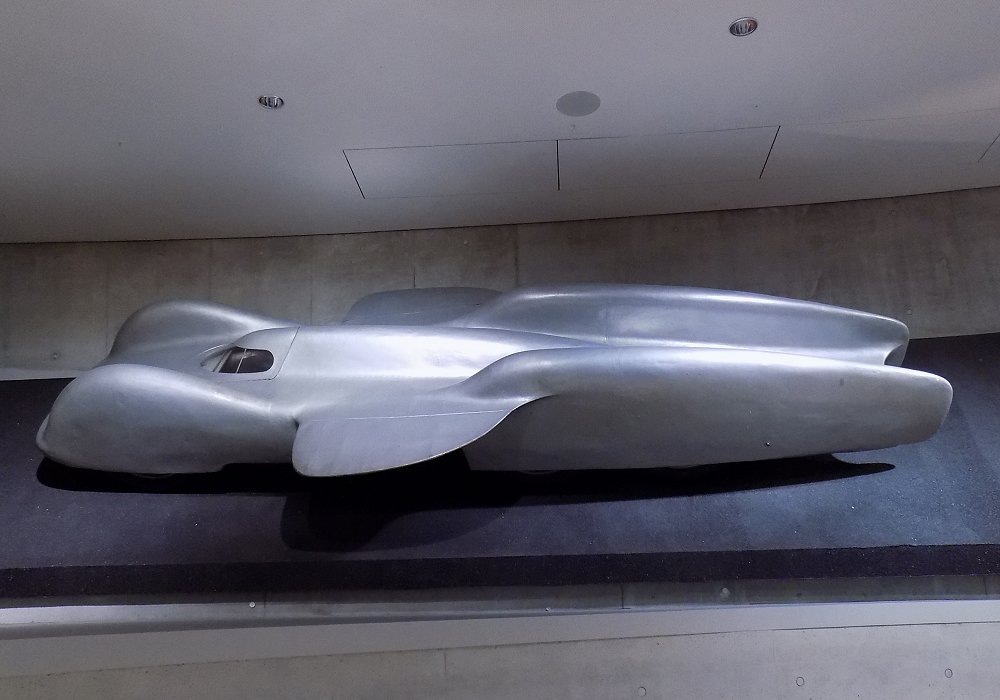
The chassis of the Mercedes-Benz T80 was a massive tubular spaceframe designed to support the aircraft engine and withstand the stresses associated with extreme speed. The car featured three axles, with one at the front and two at the rear, giving it a six-wheel configuration. This layout was chosen to improve stability and distribute weight more evenly, reducing the risk of loss of control at very high velocities. Suspension was minimal and stiff, as the car was intended to run on a smooth, prepared surface rather than uneven terrain.
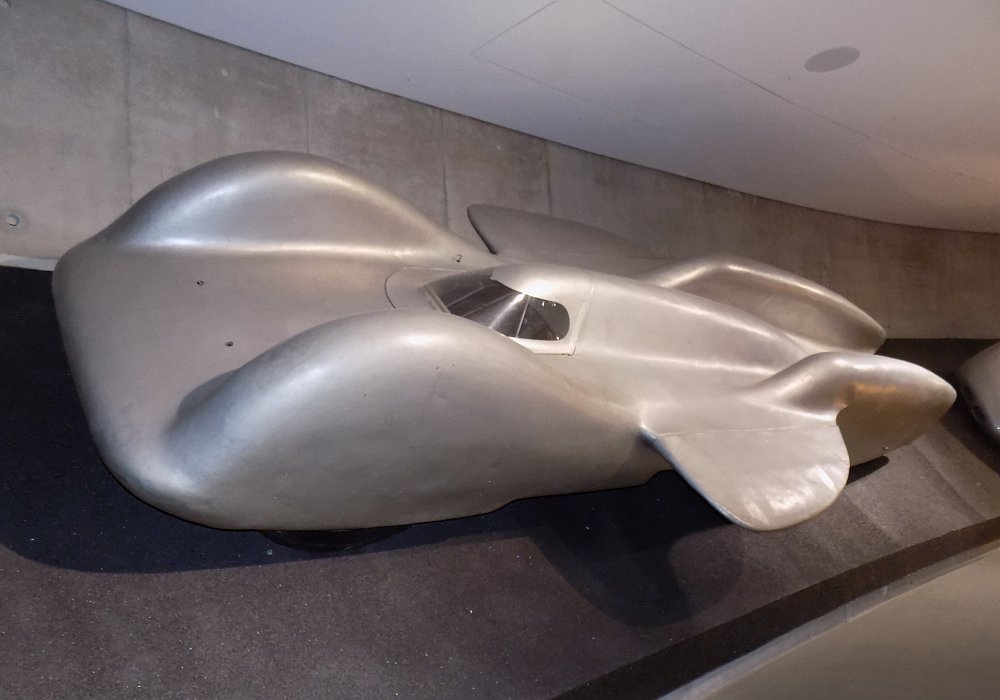
Aerodynamics were central to the T80’s design. The bodywork was developed with extensive input from aerodynamics specialists and was shaped to minimise drag while maintaining stability. The resulting form was long, low and exceptionally sleek, with a sharply pointed nose, smooth flanks and a tapered tail. Fully enclosed wheels, carefully shaped air intakes and an elongated tail section were all intended to reduce turbulence and keep airflow attached at speeds far beyond those reached by earlier record cars. Small stabilising fins were incorporated to improve directional stability, reflecting the influence of aircraft design principles.
The driver’s cockpit was located far forward within the body and was extremely confined. Visibility was limited, and the driving environment was harsh, hot and noisy. Instrumentation was sparse, focusing only on essential engine and speed data. The T80 was intended to be driven by Hans Stuck, one of Germany’s most experienced and fearless drivers, who had already set multiple speed records for Mercedes-Benz. The projected target speed for the T80 exceeded 600 km/h, a figure that would have shattered existing records and redefined what was thought possible for a wheeled vehicle.
The record attempt was planned to take place on a specially prepared stretch of autobahn near Dessau in early 1940. However, the outbreak of the Second World War in September 1939 brought the project to an abrupt halt. Resources were diverted to military production, and the T80 was never given the opportunity to make its record attempt. As a result, the car never ran at full speed under record conditions, leaving its true performance potential forever unproven.
Despite never setting a record, the Mercedes-Benz T80 Rekordwagen occupies a unique place in automotive history. It represents the ultimate expression of pre-war engineering ambition, unconstrained by regulations, cost or practicality. The sheer scale of its power, its integration of aviation technology and its purpose-built aerodynamic design place it in a category of its own.
Today, the Mercedes-Benz T80 survives as a museum exhibit, preserved as a testament to an era when speed records were pursued with uncompromising boldness. It stands as a symbol of engineering imagination interrupted by history, and as a reminder that, had circumstances been different, the boundaries of automotive performance might have been pushed decades ahead of their time.