Description
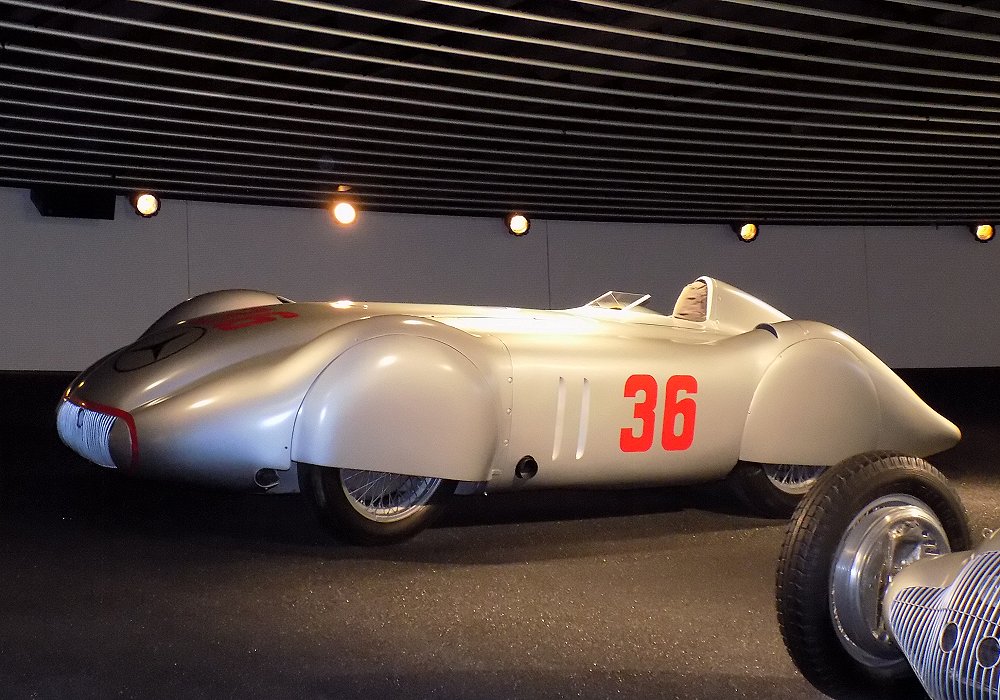
The Mercedes-Benz W25 Avus Stromlinien was one of the most extreme and specialised Grand Prix cars ever constructed, created specifically for the 1937 Avusrennen in Berlin. Based on the already formidable W25 Grand Prix car, the Avus Stromlinien variant was engineered for one purpose only: maximum speed on the Avus circuit’s unique layout, which consisted largely of long straights and steeply banked curves. It represented the purest expression of pre-war aerodynamic experimentation and remains one of the most visually arresting racing cars in history.
At its core, the Avus Stromlinien used a development of the W25’s supercharged inline-eight engine. Displacement at this stage had grown to approximately 5.6 litres, and power output was estimated to be in the region of 600 horsepower, an extraordinary figure for the 1930s. A Roots-type supercharger delivered immense boost, producing brutal acceleration and exceptional top speed. The engine was tuned specifically for sustained high-speed running rather than circuit versatility, and power was transmitted through a manual gearbox optimised for the Avus circuit’s long, flat-out sections.
The chassis was derived from the W25 tubular frame but modified to suit the demands of extreme speed. Weight distribution and suspension geometry were adjusted to provide stability at very high velocities, particularly on the circuit’s fearsome north curve, which featured steep banking and limited safety margins. Independent front suspension with coil springs was retained, along with a rear swing-axle layout, though both were stiffened to reduce movement at speed. Braking systems were of limited importance on the Avus layout, as braking zones were minimal, but they still had to cope with the enormous speeds generated by the car.
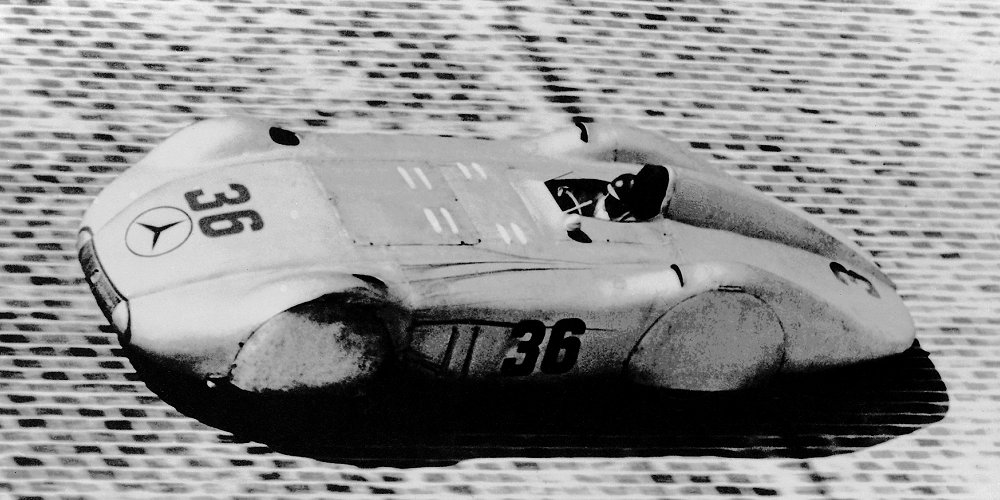
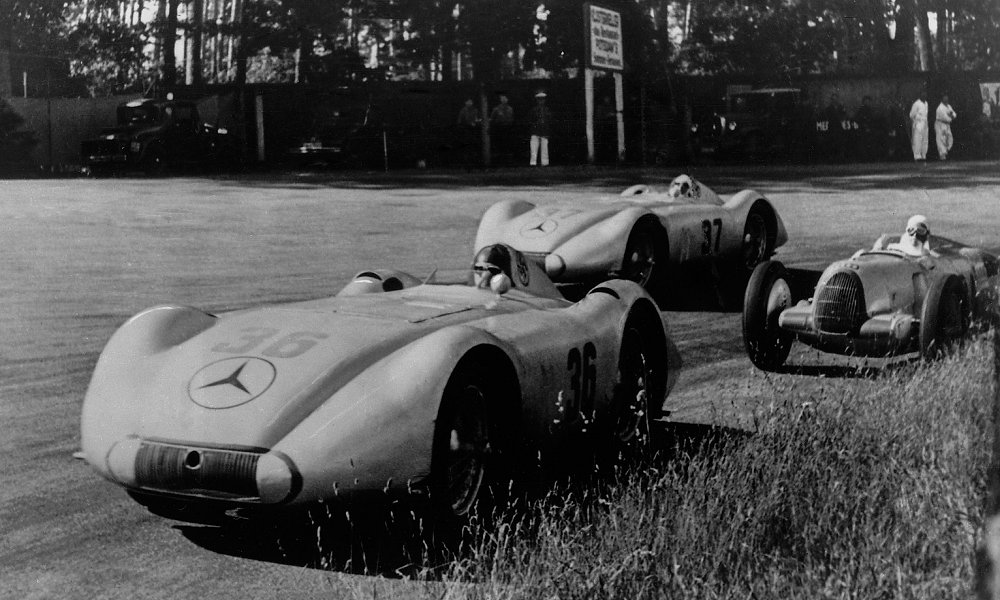
What truly set the W25 Avus Stromlinien apart was its bodywork. Unlike the exposed-wheel configuration of the standard W25, this version was fully enclosed in a smooth, teardrop-shaped aluminium shell designed to minimise aerodynamic drag. The front wheels were completely covered, the body sides flowed uninterrupted from nose to tail, and the cockpit opening was reduced to the smallest practical size. Cooling openings were minimised and carefully shaped, and the overall form resembled contemporary aircraft fuselage research more than traditional racing cars. The resulting appearance was futuristic, almost alien, even by modern standards.
The driver sat enclosed deep within the streamlined body, with minimal visibility and very limited escape options. Instrumentation was sparse, and heat buildup inside the cockpit was extreme due to the enclosed design and proximity of the supercharged engine. Driving the Avus Stromlinien required immense courage, as the car reached speeds well beyond 350 km/h on the straights, with little protection and almost no margin for error. The steeply banked curves of the Avus circuit added further danger, as any loss of control at speed would have been catastrophic.
In competition, the W25 Avus Stromlinien achieved its intended goal. Driven by Rudolf Caracciola and Hermann Lang, the cars dominated the 1937 Avusrennen, with Lang achieving an outright victory. The sheer speed of the streamlined Mercedes cars overwhelmed the competition, and the event became a dramatic demonstration of Germany’s technical prowess in both motorsport and aerodynamics. However, the race also highlighted the extreme risks involved, as tyre failures and stability concerns pushed both drivers and machines to their absolute limits.
The Avus Stromlinien was never intended as a general-purpose Grand Prix car. Its fully enclosed body made it unsuitable for conventional circuits with frequent braking, cornering and varying speeds. As a result, it was used only for the Avus race and remained a highly specialised experimental machine rather than a template for future designs. Subsequent Mercedes Grand Prix cars returned to open-wheel configurations, as regulations and practical considerations limited the use of full streamlining.
Today, the Mercedes-Benz W25 Avus Stromlinien is regarded as one of the most spectacular and daring racing cars ever built. It stands as a symbol of an era when engineering ambition was limited only by imagination and courage, and when speed was pursued with little regard for safety by modern standards. As an artifact of motorsport history, it represents the absolute extreme of pre-war aerodynamic experimentation and remains one of the most iconic expressions of the Silver Arrow legend.