Description
The Messerschmitt KR 200 Kabinenroller was one of the most distinctive microcars of the 1950s and became an enduring symbol of post-war European ingenuity. Produced in West Germany from 1955 to 1964, the KR 200 evolved from the earlier KR 175 and reflected the economic realities of the period, when affordable, fuel-efficient transport was in high demand.
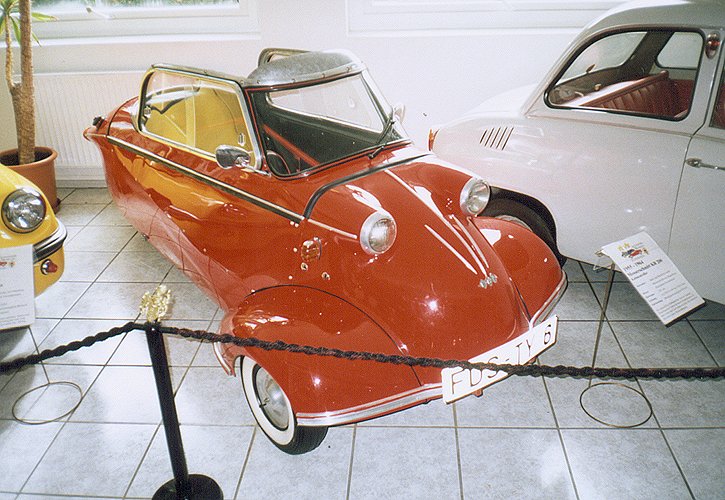
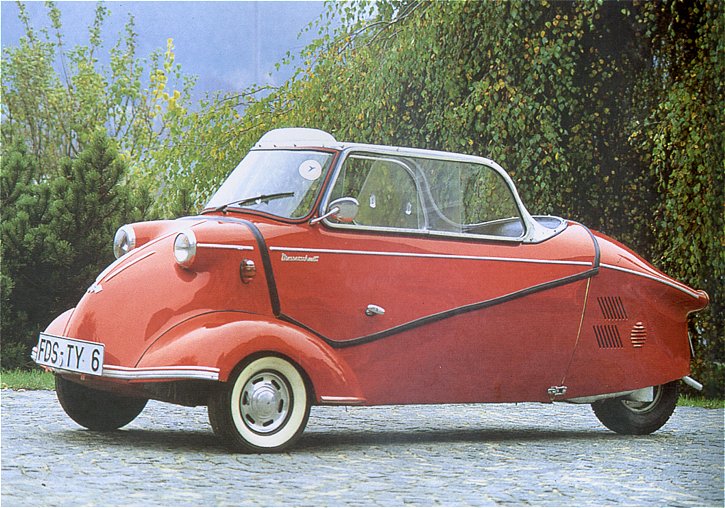
The term “Kabinenroller” translates roughly to “cabin scooter,” accurately describing the car’s origins and concept. Developed by Messerschmitt, a company better known for aircraft production, the KR 200 carried clear aviation influences. Its narrow body, tandem seating arrangement and clear bubble canopy gave it an unmistakable aircraft-inspired appearance. Occupants sat one behind the other, similar to a fighter plane cockpit, rather than side by side as in conventional cars.
Power came from a single-cylinder, two-stroke engine of approximately 191 cc, mounted at the rear. Despite its modest displacement, the lightweight construction of the KR 200 allowed it to achieve respectable performance for its class, with a top speed around 90 km/h depending on specification. A four-speed manual gearbox was fitted, often without a conventional reverse gear. Instead, early versions reversed engine rotation to provide backward movement.
The chassis consisted of a tubular steel frame with lightweight body panels. The narrow track and three-wheel configuration reduced manufacturing complexity and kept weight to a minimum. Front suspension used leading arms, while the single rear wheel was driven directly by the engine. The design prioritised simplicity, economy and ease of maintenance.
The bubble canopy was one of the KR 200’s most memorable features. Hinged to one side, it opened upward to allow entry. Some versions were also available with a fixed windscreen and fabric roof for improved practicality. Steering was controlled by a handlebar-style wheel in early models, later replaced with a more conventional steering wheel.
The Messerschmitt KR 200 emerged during a period when Germany was rebuilding its economy, and small, affordable vehicles were essential for personal mobility. It offered an economical alternative to full-sized cars while providing more weather protection and stability than a motorcycle.
Production numbers were significant for a microcar, and the KR 200 found buyers across Europe and beyond. Its unusual design and practical efficiency made it both a curiosity and a genuinely useful vehicle in its time.
Today, the Messerschmitt KR 200 Kabinenroller is regarded as an icon of 1950s microcar engineering. Its aircraft-inspired styling, lightweight construction and clever mechanical solutions make it highly collectible. As a historical vehicle, it represents a creative response to economic necessity and stands as a reminder of how innovation can flourish even under constraint.