Description
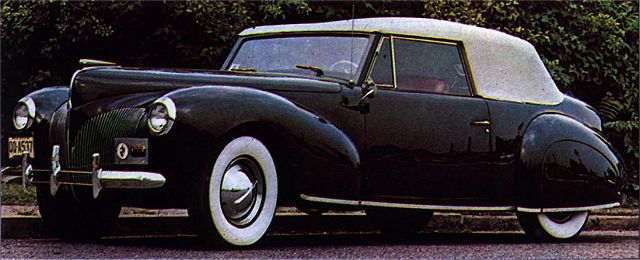
The Lincoln Continental V12 was one of the most refined and iconic American automobiles of the late 1930s and early 1940s, a car that defined the essence of understated luxury and elegance. Conceived under the direction of Edsel Ford and designed by Eugene T. “Bob” Gregorie, the Continental was originally intended not as a mass-produced model but as a personal car for Edsel himself—a sophisticated, European-inspired grand tourer that would blend style, power, and restraint. The result was a design so graceful and distinctive that it entered production and soon became one of the most admired automobiles of its age, earning a place among the great classics of American automotive design.
The story of the Continental began in 1938, when Edsel Ford, president of the Lincoln division, requested a special, low-slung version of the Lincoln Zephyr to use on his winter holiday in Florida. Gregorie, who headed Ford’s design department, responded by creating a car that was both elegant and modern, featuring long flowing lines, a low roof, and minimal ornamentation. When Edsel arrived in Palm Beach with the prototype, it caused an immediate sensation—friends and admirers asked where they could buy one. That enthusiasm convinced Ford to put the car into limited production for 1940 under the name Lincoln Continental.
At the heart of the Lincoln Continental was Lincoln’s 4.8-litre (292 cubic inch) V12 engine, the same unit used in the Zephyr. This smooth-running, liquid-cooled engine produced around 120 horsepower and was renowned for its quietness and refined character rather than sheer performance. Power was delivered through a three-speed manual transmission with optional overdrive, allowing effortless high-speed cruising. The V12’s torque delivery was particularly impressive, providing seamless acceleration and a sense of serene power that suited the car’s grand touring personality.
The Continental’s chassis was derived from the Zephyr’s unit-body design, which integrated the frame and body into a single structure for strength and lightness. The car had a wheelbase of 125 inches, making it slightly shorter and more compact than the standard Zephyr sedan, while maintaining excellent proportions. The suspension employed transverse leaf springs at the front and semi-elliptic springs at the rear, giving the car a supple, controlled ride. Hydraulic brakes on all four wheels provided reliable stopping power, and steering was light and precise for a car of its size.
The Continental’s design was what truly set it apart. Gregorie’s styling was influenced by European touring cars, particularly those from the likes of Delahaye and Bentley. The car’s long bonnet, short rear deck, and low roofline created a perfect balance of grace and proportion. The fenders flowed smoothly into the body, and the absence of excessive chrome or ornamentation gave the car an elegant simplicity that contrasted sharply with the more flamboyant designs of the era. The distinctive rear-mounted spare wheel—a design feature that would later become known as the “Continental kit”—added both visual interest and practical functionality, quickly becoming one of the model’s trademarks.
The Lincoln Continental was available in two main body styles: a two-door Cabriolet (convertible) and a two-door Club Coupe (fixed roof). Both shared the same long, sculpted bodywork and fine detailing. The convertible, in particular, epitomized the Continental’s blend of luxury and freedom—a car equally at home parked in front of a country estate or gliding along the coastal roads of California or the Riviera.
Inside, the Continental’s cabin was designed to be as tasteful and refined as its exterior. Materials were of the highest quality—fine leather upholstery, polished wood accents, and chrome trim used sparingly but effectively. The dashboard was clean and symmetrical, with elegantly arranged gauges and controls that reflected the precision of the car’s engineering. Seating was generous and deeply cushioned, offering true comfort for long journeys. Even small details, such as the door handles and switchgear, were crafted with a jeweller’s attention to design and feel.
On the road, the Continental delivered exactly the kind of experience Edsel Ford had envisioned—smooth, quiet, and composed. The V12 engine provided ample power for effortless cruising, while the car’s aerodynamic form reduced wind noise and improved high-speed stability. The ride quality was superb, absorbing bumps and imperfections with poise, and the handling, though not sporty by modern standards, was predictable and balanced. Drivers praised its light steering and near-silent operation, qualities that made it one of the most refined American cars of its time.
The Lincoln Continental was introduced to the public in 1940 and immediately attracted widespread acclaim. Critics hailed it as one of the most beautiful automobiles ever built, and it quickly became a status symbol for America’s elite. Notable owners included Frank Lloyd Wright, Rita Hayworth, and Henry Fonda. Its design was so well regarded that the Museum of Modern Art in New York later recognized it as a work of art, including it in its 1951 “Eight Automobiles” exhibition as an example of functional modern design.
Production of the original Continental continued through 1942, when civilian car manufacturing was halted due to World War II. After the war, the model returned in 1946 with minor updates, including a slightly revised grille and upgraded interior fittings, before production ended in 1948. In total, fewer than 5,000 first-generation Continentals were built, making them among the rarest and most collectible Lincolns ever produced.
Today, the Lincoln Continental V12 stands as a masterpiece of prewar American design—a car that seamlessly blended European-inspired style with American craftsmanship and mechanical refinement. It represents the height of Edsel Ford’s design philosophy: elegance through restraint, luxury without ostentation. Collectors value the Continental not only for its rarity and beauty but for its historical importance as the car that defined the concept of the “personal luxury automobile,” a template that would influence American design for decades.
The Continental’s legacy endures in every Lincoln that followed. Its long hood, clean lines, and rear-mounted spare became design hallmarks, and its emphasis on personal sophistication rather than sheer extravagance redefined what luxury meant in the American automotive world. More than a car, the Lincoln Continental V12 was a statement of taste and refinement—a timeless symbol of elegance in motion.